Birth Chart
Karl Schmidt-Rottluff
Sun Sagittarius
Moon Taurus
Ascendant Scorpio
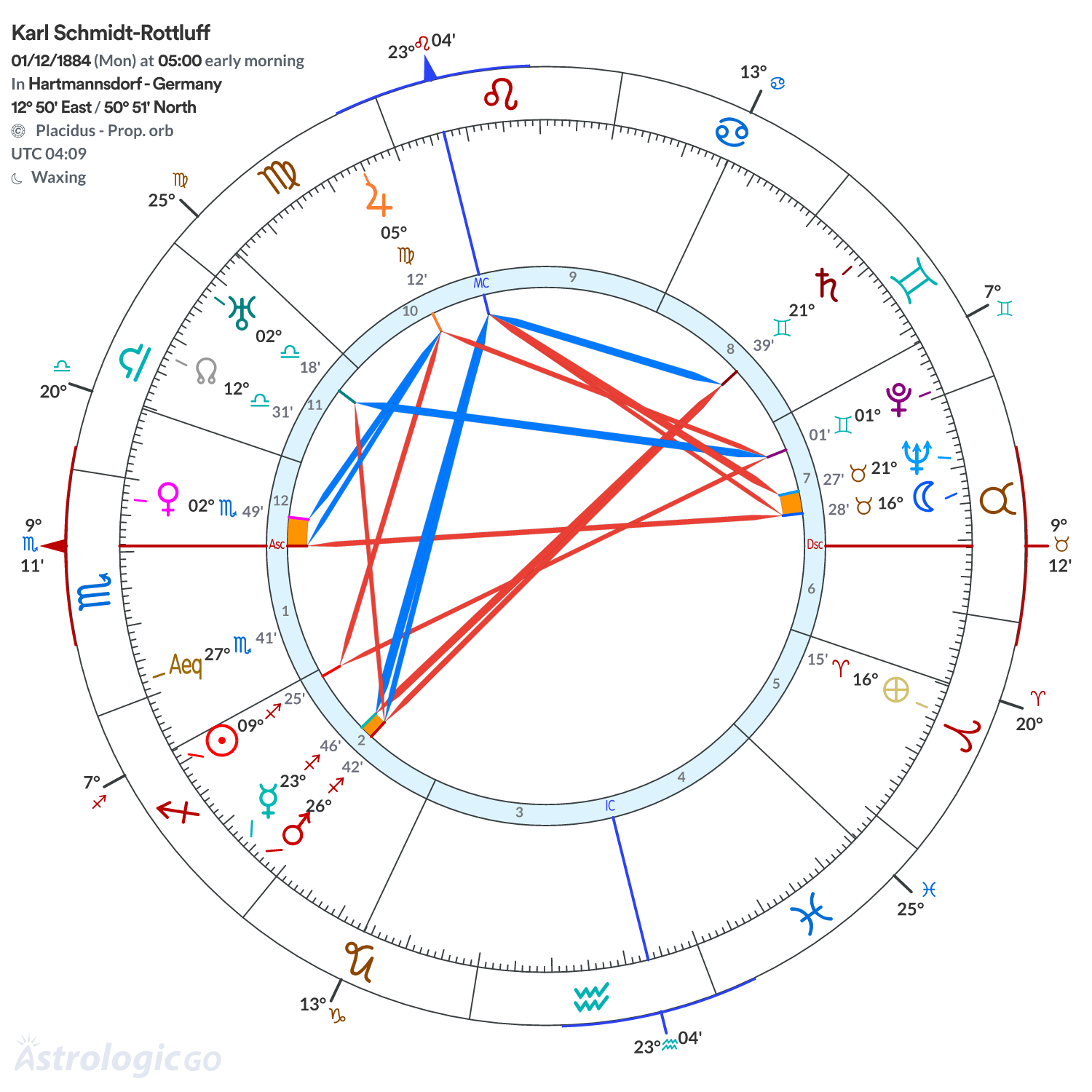
Influences in signs
↣ Sun in Sagittarius - 09°26' - in house 2
↣ Moon in Taurus - 16°29' - in house 7
↣ Mercury in Sagittarius - 23°46' - in house 2
↣ Venus in Scorpio - 02°49' - in house 12
↣ Mars in Sagittarius - 26°43' - in house 2
↣ Jupiter in Virgo - 05°13' - in house 10
↣ Saturn in Gemini - 21°40' - in house 8 - retrograde
↣ Uranus in Libra - 02°19' - in house 11
↣ Neptune in Taurus - 21°27' - in house 7 - retrograde
↣ Pluto in Gemini - 01°01' - in house 7/8 - retrograde
↣ North Node in Libra - 12°31' - in house 11/12 - retrograde
↣ Ascendant in Scorpio - 09°12' - in house 1
↣ Midheaven in Leo - 23°05' - in house 10
↣ Equatorial Ascendant in Scorpio - 27°41'
Influences in houses
↣ Sun in house 2
↣ Moon in house 7
↣ Mercury in house 2
↣ Venus in house 12
↣ Mars in house 2
↣ Jupiter in house 10
↣ Saturn in house 8
↣ Uranus in house 11
↣ Neptune in house 7
↣ Pluto in house 7/8
↣ North Node in house 11/12
↣ Ascendant in house 1
↣ Midheaven in house 10
Aspects
↣ Sun and Jupiter square (4°14' separating)
↣ Sun and Saturn antiparallel
↣ Sun and Pluto opposition (8°25' separating)
↣ Sun and North Node sextile (3°05' applying)
↣ Sun and Equatorial Ascendant conjunction (11°44' applying)
↣ Moon and Neptune conjunction (4°58' applying)
↣ Moon and Equatorial Ascendant opposition (11°13' separating)
↣ Moon and Ascendant opposition (7°17' applying) antiparallel
↣ Moon and Midheaven square (6°36' separating) parallel
↣ Mercury and Mars conjunction (2°56' applying)
↣ Mercury and Saturn opposition (2°07' separating)
↣ Mercury and Midheaven trine (0°41' applying)
↣ Venus and Jupiter sextile (2°23' applying) antiparallel
↣ Venus and Ascendant conjunction (6°23' separating)
↣ Mars and Saturn opposition (5°03' separating)
↣ Mars and Uranus square (5°36' applying)
↣ Mars and Midheaven trine (3°38' applying)
↣ Jupiter and Pluto square (4°11' separating)
↣ Jupiter and Ascendant sextile (4°00' separating)
↣ Saturn and Midheaven sextile (1°25' separating)
↣ Uranus and Pluto trine (1°17' separating)
↣ Uranus and Equatorial Ascendant sextile (4°37' applying) parallel
↣ Neptune and Equatorial Ascendant opposition (6°15' separating)
↣ Neptune and Midheaven square (1°38' separating)
↣ Pluto and Equatorial Ascendant opposition (3°20' applying)
Birth data
- Chart date
- 01/12/1884
- Chart time
- 05:00
- Date and time quality
- AA Birth record cited what does this mean?
- Data origin
- Astro-Databank
- Location
-
 Hartmannsdorf, Germany
 - Latitude and longitude
- 50°51' North · 12°50' East
- Time zone
- 00:51 East
The data used to calculate the charts comes from public sources, as do the descriptive texts. We use sources such as Wikipedia.

About
Karl Schmidt-Rottluff was a German painter and printmaker, a central figure of Expressionism and one of the four founders of the group Die Brücke. Trained initially in architecture, he soon left his studies to devote himself to the arts and, together with colleagues such as Erich Heckel and Ernst Ludwig Kirchner, pursued a radical visual language that broke with academic traditions. His work was notable for compositional balance, simplified forms and a tendency to emphasize the flatness of surfaces.
He was a pioneer in the revival of woodcut as an expressive medium, producing hundreds of prints over his career and also exploring wood sculpture. Between 1907 and 1920 he developed variations ranging from angular lines and more restrained colors to later work with flat shapes and softer contours, while maintaining a lifelong commitment to landscape.
Persecuted by the Nazi regime — expelled from institutions, with works confiscated and labeled “degenerate” — part of his output was lost during the Second World War. After the conflict he took part in Germany’s artistic renewal as a professor at the Berlin art university and helped establish the Brücke Museum, leaving a lasting presence in international public collections and in the historiography of Expressionism.


