Birth Chart
Mary Somerville
Mary Fairfax
Sun Capricorn
Moon Capricorn
When the birth time is unknown, the chart is calculated for 12:00 noon without using the astrological houses system. Are the planets in the wrong houses?
Influences in signs
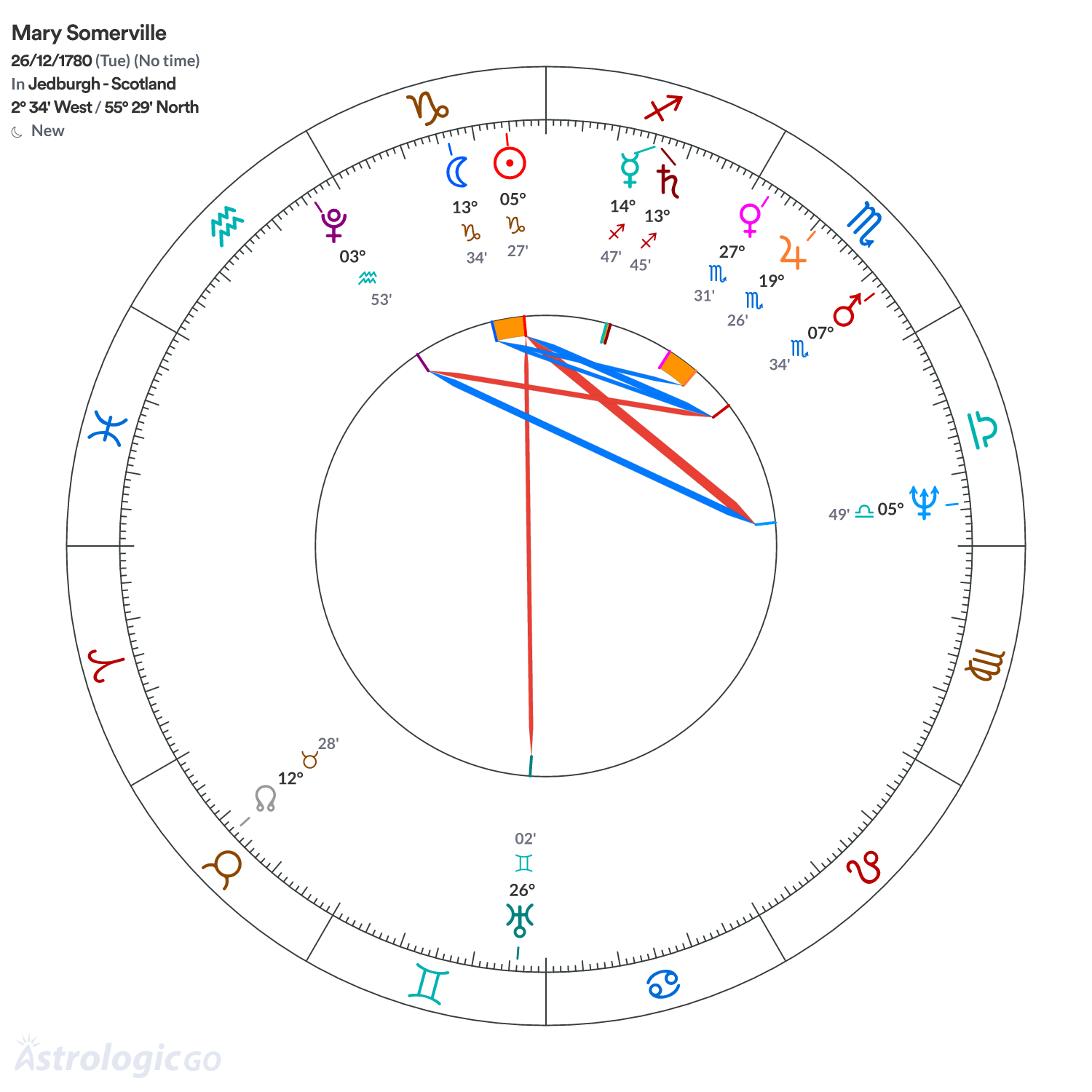
↣ Sun in Capricorn - 05°28'
↣ Moon in Capricorn - 13°34'
↣ Mercury in Sagittarius - 14°47'
↣ Venus in Scorpio - 27°32'
↣ Mars in Scorpio - 07°34'
↣ Jupiter in Scorpio - 19°27'
↣ Saturn in Sagittarius - 13°46'
↣ Uranus in Gemini - 26°03' - retrograde
↣ Neptune in Libra - 05°50'
↣ Pluto in Aquarius - 03°53'
↣ North Node in Taurus - 12°28' - retrograde
Aspects
↣ Sun and Moon conjunction (8°07' separating)
↣ Sun and Mars sextile (2°07' applying)
↣ Sun and Uranus opposition (9°24' separating) antiparallel
↣ Sun and Neptune square (0°22' applying)
↣ Sun and Pluto parallel
↣ Moon and Mars sextile (6°00' separating)
↣ Moon and Jupiter sextile (5°53' applying)
↣ Moon and North Node trine (1°06' separating)
↣ Mercury and Saturn conjunction (1°01' separating)
↣ Venus and Jupiter conjunction (8°05' separating) parallel
↣ Mars and Pluto square (3°41' separating)
↣ Mars and North Node opposition (4°54' applying)
↣ Jupiter and North Node opposition (6°59' separating)
↣ Uranus and Pluto antiparallel
↣ Neptune and Pluto trine (1°56' applying)
Birth data
- Original name
- Mary Fairfax
- Chart date
- 26/12/1780
- Chart time
- No time
- Date and time quality
- B Biography/autobiography what does this mean?
- Data origin
- Astro-Databank
- Location
-
 Jedburgh, Scotland
 - Latitude and longitude
- 55°29' North · 2°34' West
- Time zone
- 00:10 West
The data used to calculate the charts comes from public sources, as do the descriptive texts. We use sources such as Wikipedia.

About
Mary Somerville was a Scottish scientist, scientific writer, and polymath whose work helped spread mathematics and astronomy in the 19th century. Largely self-taught, she studied algebra and geometry and the works of Isaac Newton and Pierre-Simon Laplace, translating complex mathematical developments into texts accessible to the educated public of her time. Her solutions to mathematical problems and the silver medal she received in 1811 established her reputation among scholars.
Somerville also served as a science communicator: her books and essays made advanced theories understandable to non-specialist readers, widening the impact of the era’s scientific discoveries. She was the first woman named to the Royal Astronomical Society alongside Caroline Herschel, a milestone of institutional recognition in a field then dominated by men.
Committed to the liberal causes of her day, she signed the petition coordinated by John Stuart Mill in support of female suffrage, viewing education and public participation as instruments of justice. Her combination of scientific work, talent for popularization, and public stance earned her the epithet “queen of 19th-century science” in contemporary newspapers, leaving a legacy as a model of a woman scientist and intellectual in the Victorian context.


