Birth Chart
Mikhail Bakunin
Mikhail Alexandrovich Bakunin
Sun Gemini
Moon Libra or Scorpio
When the birth time is unknown, the chart is calculated for 12:00 noon without using the astrological houses system. Are the planets in the wrong houses?
Influences in signs
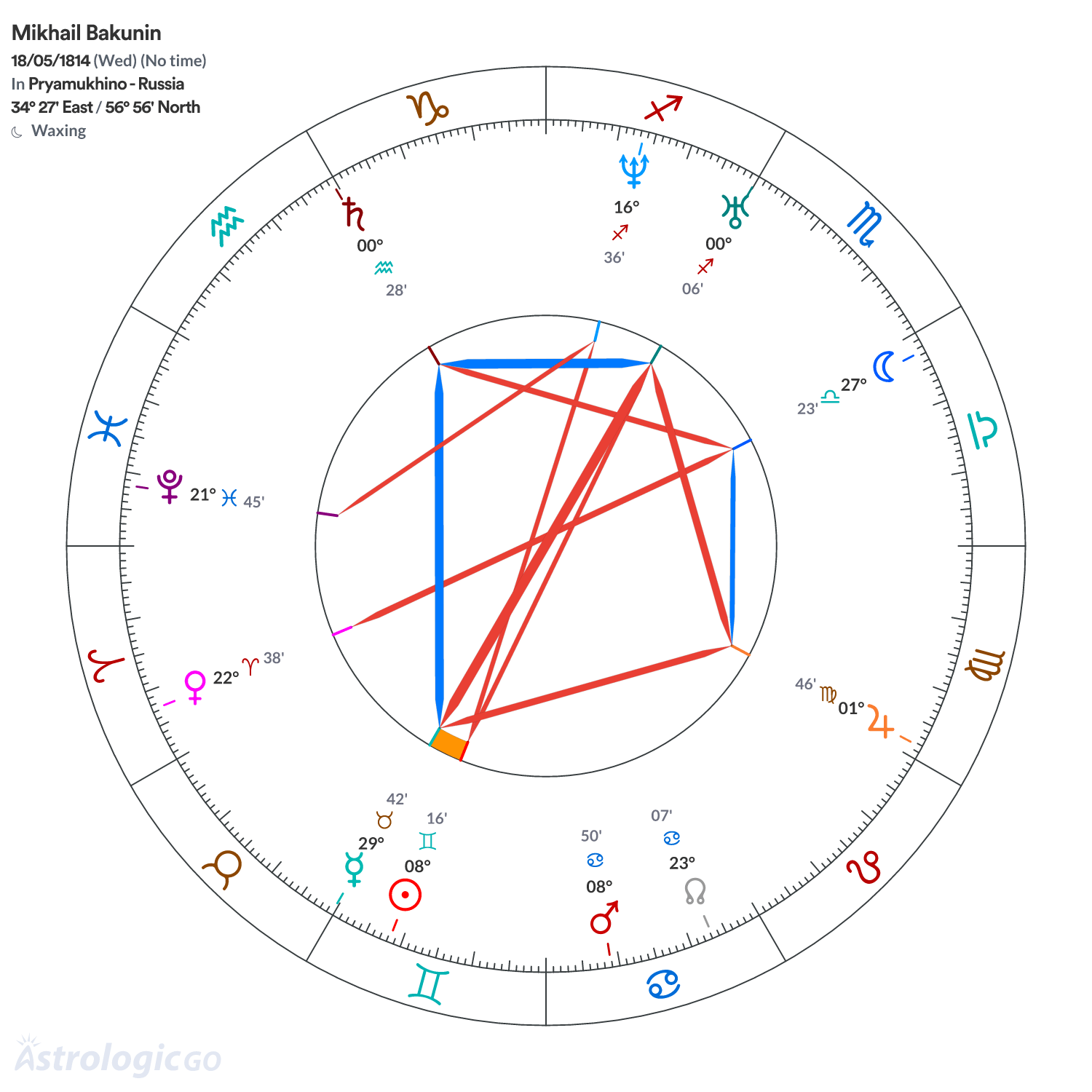
↣ Sun in Gemini - 08°17'
↣ Moon in Libra - 27°23'
↣ Mercury in Taurus - 29°42'
↣ Venus in Aries - 22°38'
↣ Mars in Cancer - 08°51'
↣ Jupiter in Virgo - 01°46'
↣ Saturn in Aquarius - 00°28' - retrograde
↣ Uranus in Sagittarius - 00°07' - retrograde
↣ Neptune in Sagittarius - 16°36' - retrograde
↣ Pluto in Pisces - 21°45'
↣ North Node in Cancer - 23°08' - retrograde
Aspects
↣ Sun and Mercury conjunction (8°35' applying)
↣ Sun and Saturn antiparallel
↣ Sun and Uranus opposition (8°10' separating)
↣ Sun and Neptune opposition (8°19' applying) antiparallel
↣ Sun and North Node parallel
↣ Moon and Venus opposition (4°45' separating) antiparallel
↣ Moon and Jupiter sextile (4°23' applying)
↣ Moon and Saturn square (3°05' applying)
↣ Moon and North Node square (4°15' separating)
↣ Mercury and Jupiter square (2°04' applying)
↣ Mercury and Saturn trine (0°46' applying) antiparallel
↣ Mercury and Uranus opposition (0°24' applying) antiparallel
↣ Venus and North Node square (0°30' applying)
↣ Jupiter and Uranus square (1°40' separating)
↣ Saturn and Uranus sextile (0°22' separating) parallel
↣ Saturn and North Node opposition (7°20' separating)
↣ Neptune and Pluto square (5°09' separating)
↣ Neptune and North Node antiparallel
↣ Pluto and North Node trine (1°23' applying)
Birth data
- Original name
- Mikhail Alexandrovich Bakunin
- Chart date
- 18/05/1814 Julian
- Chart time
- No time
- Date and time quality
- XX Time not informed what does this mean?
- Data origin
- Astro-Databank
- Location
-
 Pryamukhino, Russia
 - Latitude and longitude
- 56°56' North · 34°27' East
- Time zone
- 02:18 East
The data used to calculate the charts comes from public sources, as do the descriptive texts. We use sources such as Wikipedia.

About
Mikhail Alexandrovich Bakunin was a Russian political theorist, philosopher and revolutionary anarchist, recognized as one of the central figures of social anarchism. Born into a noble family, he trained in artillery before turning to philosophical studies, being deeply influenced by Fichte and Hegel and, later, by contacts with Proudhon and Marx in Paris. His career combined intense intellectual activity with practical militancy: he took part in the revolutions of 1848, endured imprisonment and exile in Siberia and, after escaping, contributed to newspapers and opposition networks across Europe.
Organizationally, Bakunin played a decisive role in expanding the anarchist current within the International Workingmen’s Association, where he engaged in theoretical and political conflict with Karl Marx over the role of the state and the revolution. A proponent of abolishing the state in favor of autonomous federations of workers, he developed ideas that integrated syndicalism and anarchism and that strongly influenced movements in Spain and elsewhere.
Among his best-known works are texts such as Statism and Anarchy and the essay God and the State. His legacy endures in the anarchist tradition as a theoretical reference and an inspiration for anti-authoritarian and federalist practices within the labor and radical movements in Europe.


