Birth Chart
Nicholas Roerich
Nicolai Konstantinovich Roerich
Sun Libra
Moon Virgo or Libra
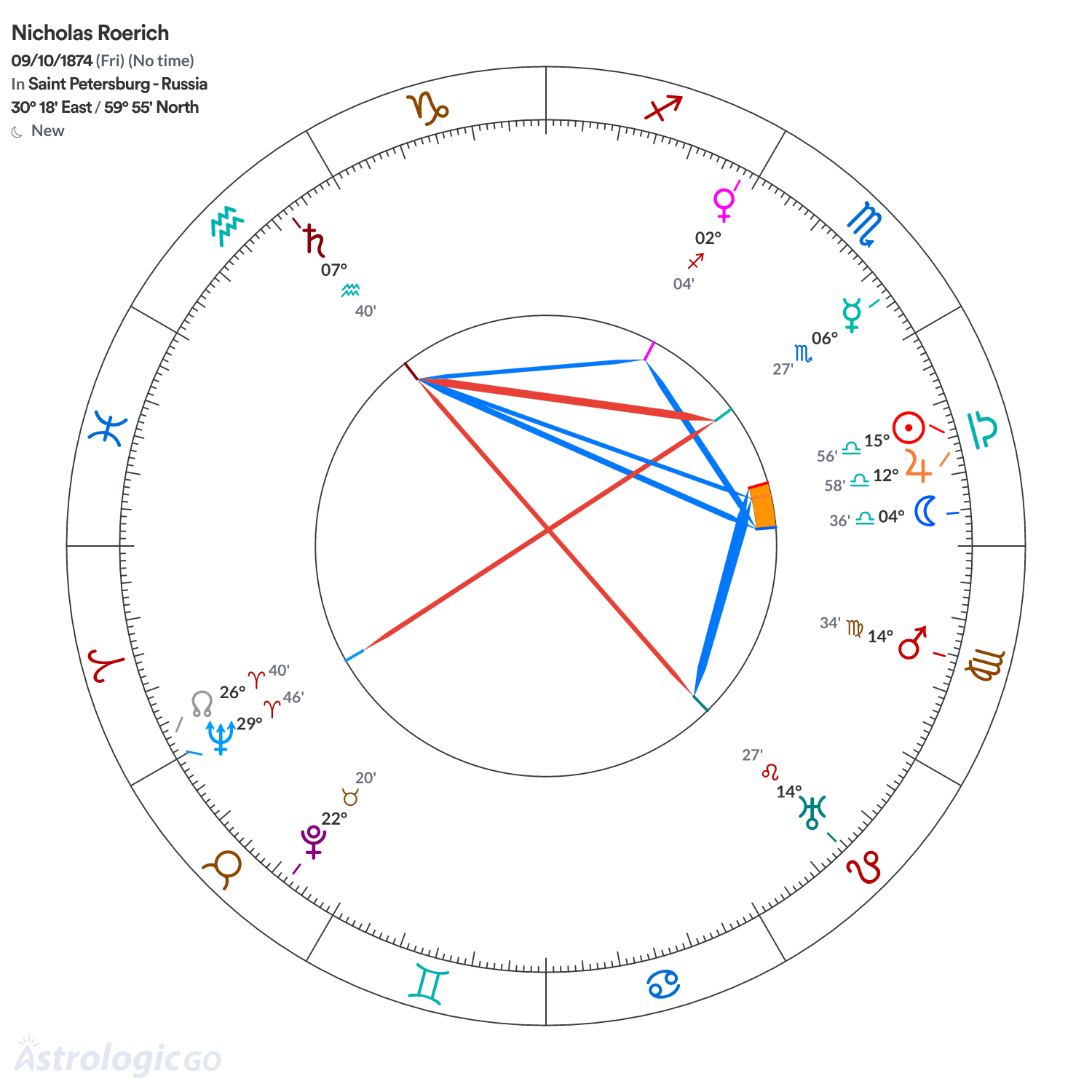
When the birth time is unknown, the chart is calculated for 12:00 noon without using the astrological houses system. Are the planets in the wrong houses?
Influences in signs
↣ Sun in Libra - 15°56'
↣ Moon in Libra - 04°37'
↣ Mercury in Scorpio - 06°28'
↣ Venus in Sagittarius - 02°05'
↣ Mars in Virgo - 14°35'
↣ Jupiter in Libra - 12°58'
↣ Saturn in Aquarius - 07°40' - retrograde
↣ Uranus in Leo - 14°28'
↣ Neptune in Aries - 29°47' - retrograde
↣ Pluto in Taurus - 22°20' - retrograde
↣ North Node in Aries - 26°40' - retrograde
Aspects
↣ Sun and Moon conjunction (11°20' applying)
↣ Sun and Mars antiparallel
↣ Sun and Jupiter conjunction (2°58' separating)
↣ Sun and Uranus sextile (1°29' separating)
↣ Moon and Venus sextile (2°32' separating)
↣ Moon and Jupiter conjunction (8°22' applying)
↣ Moon and Saturn trine (3°03' applying)
↣ Mercury and Saturn square (1°12' applying)
↣ Mercury and Neptune opposition (6°41' separating)
↣ Venus and Saturn sextile (5°35' applying)
↣ Jupiter and Saturn trine (5°18' separating)
↣ Jupiter and Uranus sextile (1°29' applying)
↣ Jupiter and Pluto antiparallel
↣ Saturn and Uranus opposition (6°48' separating)
↣ Neptune and North Node conjunction (3°06' applying) parallel
Birth data
- Original name
- Nicolai Konstantinovich Roerich
- Chart date
- 09/10/1874
- Chart time
- No time
- Date and time quality
- XX Time not informed what does this mean?
- Data origin
- Astro-Databank
- Location
-
 Saint Petersburg, Russia
 - Latitude and longitude
- 59°55' North · 30°18' East
- Time zone
- 02:01 East
The data used to calculate the charts comes from public sources, as do the descriptive texts. We use sources such as Wikipedia.

About
Nicholas Roerich (Nicolai Konstantinovich Roerich) was a Russian artist and intellectual with a multifaceted career: painter, writer, archaeologist, theosophist and cultural organizer. Known for a vast body of paintings—more than 7,000 canvases—he became noted for grand landscapes (notably of the Himalayas) and for images of a symbolic and spiritual nature, aligned with currents of Russian Symbolism and Cosmism.
Trained in both art and law, he worked as a set designer for companies such as Diaghilev’s Ballets Russes, contributing to landmark productions like The Rite of Spring, and published studies on architecture that foreshadowed his long advocacy for the preservation of artistic and architectural heritage.
Drawing on travels and expeditions across Russia and Asia, Roerich founded cultural institutions, promoted the “Banner of Peace” movement and advanced the Roerich Pact for the protection of cultural property, which gained international support. Together with his wife Helena, he systematized the doctrine known as Agni Yoga, which became the basis for a subsequent spiritual-cultural movement.
His public work combined artistic creation, activism for heritage protection and the dissemination of an esoteric thought that influenced artistic and cultural debates in the early twentieth century.


