Birth Chart
Paul Thomas Anderson
Sun Cancer
Moon Aries
Ascendant Taurus
Influences in signs
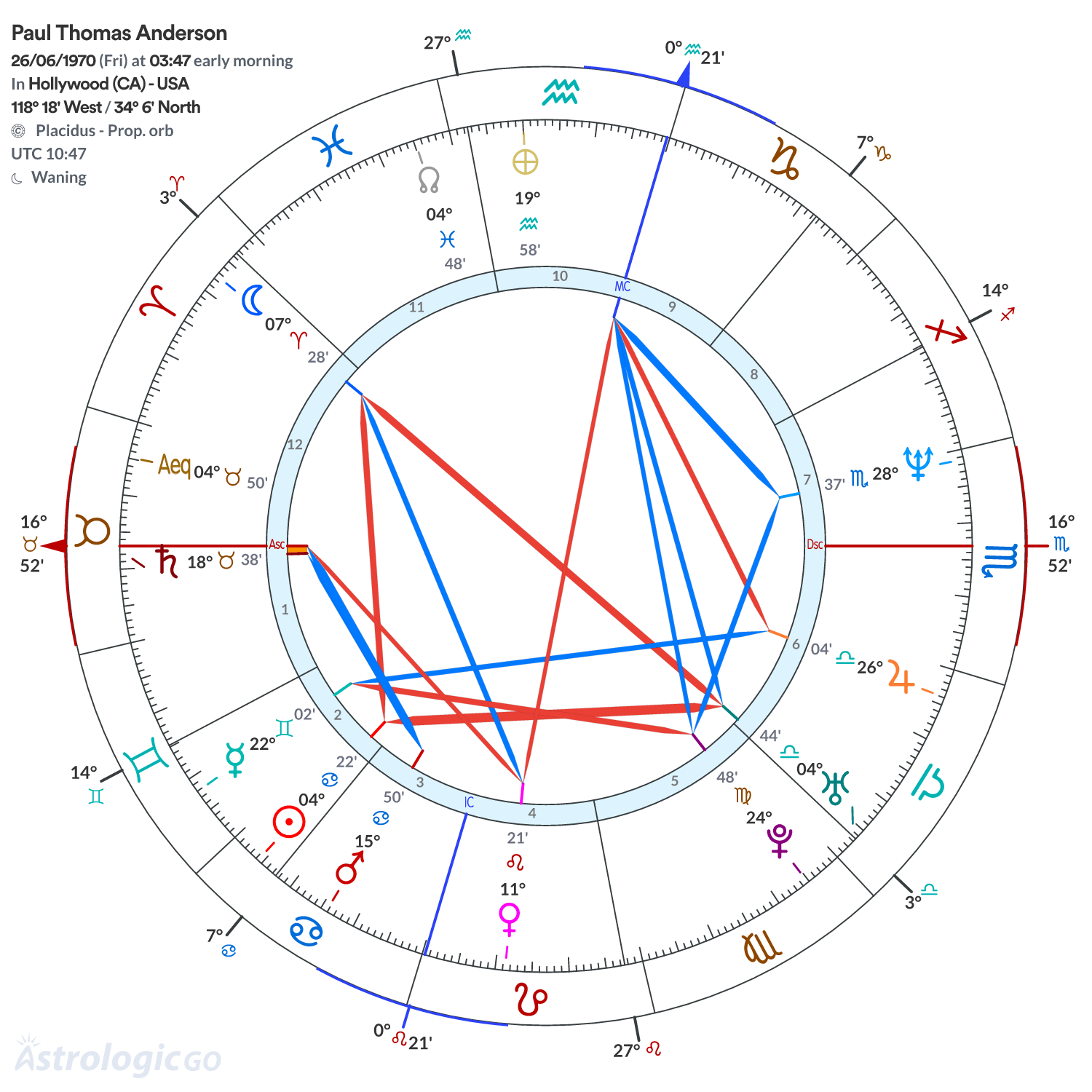
↣ Sun in Cancer - 04°22' - in house 3
↣ Moon in Aries - 07°28' - in house 12
↣ Mercury in Gemini - 22°02' - in house 2
↣ Venus in Leo - 11°22' - in house 4
↣ Mars in Cancer - 15°50' - in house 3
↣ Jupiter in Libra - 26°05' - in house 6
↣ Saturn in Taurus - 18°39' - in house 1
↣ Uranus in Libra - 04°44' - in house 6
↣ Neptune in Scorpio - 28°37' - in house 7 - retrograde
↣ Pluto in Virgo - 24°48' - in house 5/6
↣ North Node in Pisces - 04°48' - in house 11 - retrograde
↣ Ascendant in Taurus - 16°53' - in house 1
↣ Midheaven in Aquarius - 00°22' - in house 10
↣ Equatorial Ascendant in Taurus - 04°50'
Influences in houses
↣ Sun in house 3
↣ Moon in house 12
↣ Mercury in house 2
↣ Venus in house 4
↣ Mars in house 3
↣ Jupiter in house 6
↣ Saturn in house 1
↣ Uranus in house 6
↣ Neptune in house 7
↣ Pluto in house 5/6
↣ North Node in house 11
↣ Ascendant in house 1
↣ Midheaven in house 10
Aspects
↣ Sun and Moon square (3°06' separating)
↣ Sun and Mercury parallel
↣ Sun and Mars parallel
↣ Sun and Uranus square (0°22' applying)
↣ Sun and North Node trine (0°25' applying)
↣ Sun and Equatorial Ascendant sextile (0°28' separating)
↣ Moon and Venus trine (3°53' applying)
↣ Moon and Uranus opposition (2°43' separating)
↣ Mercury and Mars parallel
↣ Mercury and Jupiter trine (4°02' applying)
↣ Mercury and Pluto square (2°45' applying)
↣ Venus and Ascendant square (5°32' separating)
↣ Venus and Midheaven opposition (11°00' applying) antiparallel
↣ Mars and Saturn sextile (2°49' applying)
↣ Mars and Ascendant sextile (1°03' separating)
↣ Jupiter and North Node parallel
↣ Jupiter and Equatorial Ascendant opposition (8°45' separating)
↣ Jupiter and Midheaven square (4°17' separating)
↣ Saturn and Ascendant conjunction (1°46' applying)
↣ Uranus and Midheaven trine (4°23' applying)
↣ Neptune and Pluto sextile (3°49' applying)
↣ Neptune and Midheaven sextile (1°45' separating)
↣ Pluto and Ascendant parallel
↣ Pluto and Midheaven trine (5°34' separating)
↣ North Node and Equatorial Ascendant sextile (0°02' separating)
Birth data
- Chart date
- 26/06/1970
- Chart time
- 03:47
- Date and time quality
- AA Birth record in hand what does this mean?
- Data origin
- Astro-Databank
- Location
-
 Hollywood (CA), USA
 - Latitude and longitude
- 34°06' North · 118°18' West
- Time zone
- 07:00 West
The data used to calculate the charts comes from public sources, as do the descriptive texts. We use sources such as Wikipedia.

About
Paul Thomas Anderson is an American filmmaker known for his sophisticated screenplays and auteur direction. Since the Sundance-winning short that introduced him to the festival circuit, he has built a career with films that examine ambition, family and moral conflict, often featuring ensemble casts and intense performances.
His work includes key films of contemporary cinema: Hard Eight; Boogie Nights, which established his critical reputation; Magnolia, awarded at Berlin; Punch-Drunk Love; There Will Be Blood, widely cited among the best films of the 2000s; The Master; and Inherent Vice. He has received multiple Academy Award nominations for directing and writing, winning the directing Oscar for A Battle After the Other.
Anderson is noted for his formal rigor, attention to character psychology and recurring collaborations with actors such as Philip Seymour Hoffman and Daniel Day-Lewis. His filmography has influenced generations of independent filmmakers and established him as a central figure in contemporary American cinema.
Charts like this one
- Sun Cancer 1,129 charts
- Moon Aries 1,094 charts
- Ascendant Taurus 707 charts
- Born on June 26 49 charts