Birth Chart
Paul von Hindenburg
Paul Ludwig Hans Anton von Beneckendorff und v. H.
Sun Libra
Moon Cancer
Ascendant Capricorn
Influences in signs
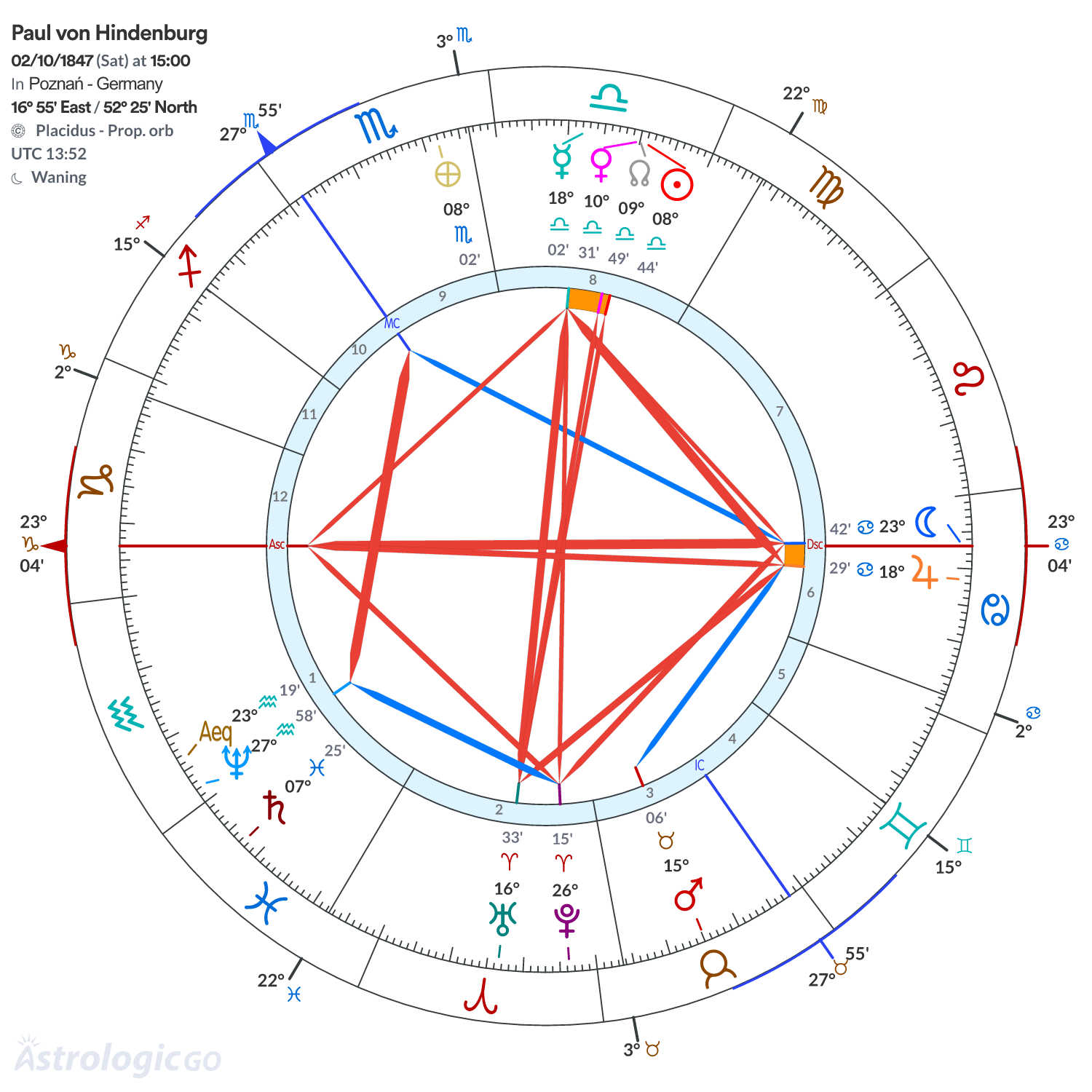
↣ Sun in Libra - 08°44' - in house 8
↣ Moon in Cancer - 23°42' - in house 7
↣ Mercury in Libra - 18°02' - in house 8
↣ Venus in Libra - 10°31' - in house 8 - retrograde
↣ Mars in Taurus - 15°06' - in house 3 - retrograde
↣ Jupiter in Cancer - 18°29' - in house 7
↣ Saturn in Pisces - 07°25' - in house 1/2 - retrograde
↣ Uranus in Aries - 16°33' - in house 2 - retrograde
↣ Neptune in Aquarius - 27°59' - in house 1 - retrograde
↣ Pluto in Aries - 26°15' - in house 2/3 - retrograde
↣ North Node in Libra - 09°49' - in house 8 - retrograde
↣ Ascendant in Capricorn - 23°05' - in house 1
↣ Midheaven in Scorpio - 27°56' - in house 10
↣ Equatorial Ascendant in Aquarius - 23°20'
Influences in houses
↣ Sun in house 8
↣ Moon in house 7
↣ Mercury in house 8
↣ Venus in house 8
↣ Mars in house 3
↣ Jupiter in house 7
↣ Saturn in house 1/2
↣ Uranus in house 2
↣ Neptune in house 1
↣ Pluto in house 2/3
↣ North Node in house 8
↣ Ascendant in house 1
↣ Midheaven in house 10
Aspects
↣ Sun and Mercury conjunction (9°18' separating)
↣ Sun and Venus conjunction (1°47' applying)
↣ Sun and Uranus opposition (7°49' applying)
↣ Sun and North Node conjunction (1°05' applying) parallel
↣ Moon and Mercury square (5°39' separating)
↣ Moon and Jupiter conjunction (5°12' separating)
↣ Moon and Pluto square (2°33' applying)
↣ Moon and Ascendant opposition (0°37' applying)
↣ Moon and Midheaven trine (4°14' separating)
↣ Mercury and Venus conjunction (7°32' separating)
↣ Mercury and Jupiter square (0°27' applying)
↣ Mercury and Uranus opposition (1°30' separating) antiparallel
↣ Mercury and Pluto opposition (8°12' applying) parallel
↣ Mercury and North Node conjunction (8°14' separating)
↣ Mercury and Equatorial Ascendant trine (5°17' separating)
↣ Mercury and Ascendant square (5°02' separating)
↣ Venus and Saturn parallel
↣ Venus and Uranus opposition (6°02' separating)
↣ Venus and North Node conjunction (0°42' applying)
↣ Mars and Jupiter sextile (3°24' separating)
↣ Jupiter and Uranus square (1°57' separating)
↣ Jupiter and Ascendant opposition (4°35' separating) antiparallel
↣ Uranus and Pluto antiparallel
↣ Uranus and North Node opposition (6°44' applying)
↣ Neptune and Pluto sextile (1°44' applying)
↣ Neptune and Equatorial Ascendant conjunction (4°39' applying)
↣ Neptune and Midheaven square (0°03' applying)
↣ Pluto and Equatorial Ascendant sextile (2°55' applying)
↣ Pluto and Ascendant square (3°10' applying)
Birth data
- Original name
- Paul Ludwig Hans Anton von Beneckendorff und v. H.
- Chart date
- 02/10/1847
- Chart time
- 15:00
- Date and time quality
- AA Birth record cited what does this mean?
- Data origin
- Astro-Databank
- Location
-
 Poznań, Germany
 - Latitude and longitude
- 52°25' North · 16°55' East
- Time zone
- 01:08 East
The data used to calculate the charts comes from public sources, as do the descriptive texts. We use sources such as Wikipedia.

About
Paul von Hindenburg was a German soldier and statesman whose career included command of the Imperial Army in World War I and the presidency of the Weimar Republic from 1925 to 1934. As a field marshal, he rose to prominence for the victory at Tannenberg (1914) alongside Erich Ludendorff and for the construction of the so-called "Hindenburg Line" on the Western Front. After the conflict he published memoirs in which he attributed part of the defeat to internal convulsions that brought an end to the Empire.
Elected president in 1925, Hindenburg became a central figure during a period of severe political and economic instability, defending conservative interests and those of the Prussian landed aristocracy. By 1932, already in his eighties, he was reelected as a candidate seen as capable of holding back the Nazi advance. Nevertheless, his decision to appoint Adolf Hitler chancellor on 30 January 1933 and his signing of decrees and laws that expanded government powers contributed to the weakening of democracy and the rise of the Nazi regime.
Hindenburg’s legacy is ambiguous: acknowledged for military leadership and national prestige, he is also remembered for the decisive role he played in transferring powers that facilitated Hitler’s dictatorship.


