Birth Chart
Pope Benedict XIV
Pròspero Lorenzo Lambertini
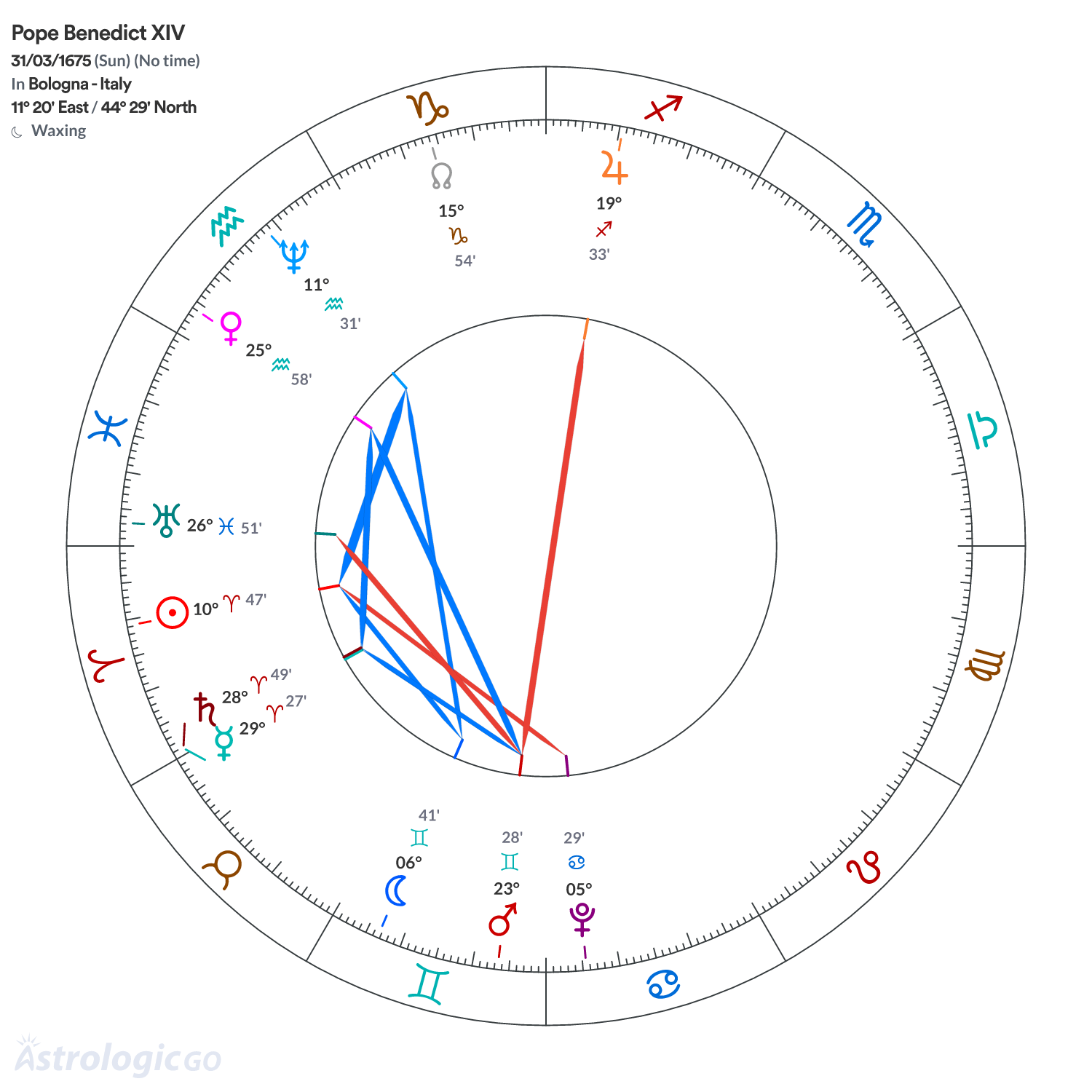
Sun Aries
Moon Gemini
When the birth time is unknown, the chart is calculated for 12:00 noon without using the astrological houses system. Are the planets in the wrong houses?
Influences in signs
↣ Sun in Aries - 10°47'
↣ Moon in Gemini - 06°41'
↣ Mercury in Aries - 29°28'
↣ Venus in Aquarius - 25°59'
↣ Mars in Gemini - 23°28'
↣ Jupiter in Sagittarius - 19°34'
↣ Saturn in Aries - 28°49'
↣ Uranus in Pisces - 26°52'
↣ Neptune in Aquarius - 11°32'
↣ Pluto in Cancer - 05°29'
↣ North Node in Capricorn - 15°55' - retrograde
Aspects
↣ Sun and Moon sextile (4°06' applying)
↣ Sun and Neptune sextile (0°44' applying)
↣ Sun and Pluto square (5°18' separating)
↣ Sun and North Node square (5°07' applying)
↣ Moon and Mars parallel
↣ Moon and Neptune trine (4°50' applying)
↣ Mercury and Venus sextile (3°29' applying)
↣ Mercury and Mars sextile (6°00' separating)
↣ Mercury and Saturn conjunction (0°39' separating)
↣ Venus and Mars trine (2°30' separating)
↣ Venus and Saturn sextile (2°51' applying)
↣ Mars and Jupiter opposition (3°55' separating)
↣ Mars and Saturn sextile (5°21' applying)
↣ Mars and Uranus square (3°24' applying)
↣ Jupiter and North Node parallel
Birth data
- Original name
- Pròspero Lorenzo Lambertini
- Chart date
- 31/03/1675
- Chart time
- No time
- Date and time quality
- XX Time not informed what does this mean?
- Data origin
- Astro-Databank
- Location
-
 Bologna, Italy
 - Latitude and longitude
- 44°29' North · 11°20' East
- Time zone
- 00:45 East
The data used to calculate the charts comes from public sources, as do the descriptive texts. We use sources such as Wikipedia.

About
Pope Benedict XIV, born Prospero Lorenzo Lambertini, was one of the most notable intellectual figures of the eighteenth-century papacy. A scholar and jurist trained in theology and law, he served as an advisor to the Roman Curia, an ecclesiastical prosecutor and the author of canonical treatises before being raised to the cardinalate and elected pope in 1740.
During his pontificate (1740–1758) he combined religious zeal with an interest in the arts and sciences: he promoted Thomism, encouraged studies of the human form, supported Baroque artistic expression and founded collections that later became part of the Vatican Museums. He was also an administrative reformer in the Papal States, changing taxation, encouraging agriculture and advocating free trade within his territories.
Firmly committed to the decrees of the Council of Trent, he worked to restore authentic liturgical practices, revised the Breviary and revived ceremonial pomp. He published numerous theological and ecclesiastical writings and sought, by peaceful means, to counter secularizing tendencies at European courts.
His legacy combines the image of a cultured and prudent pontiff: admired by contemporaries for avoiding nepotism and for combining scholarship, governance and support for the arts, he left a lasting influence on the Church’s administration and intellectual life.


