Birth Chart
Robert Cailliau
Sun Aquarius
Moon Pisces
When the birth time is unknown, the chart is calculated for 12:00 noon without using the astrological houses system. Are the planets in the wrong houses?
Influences in signs
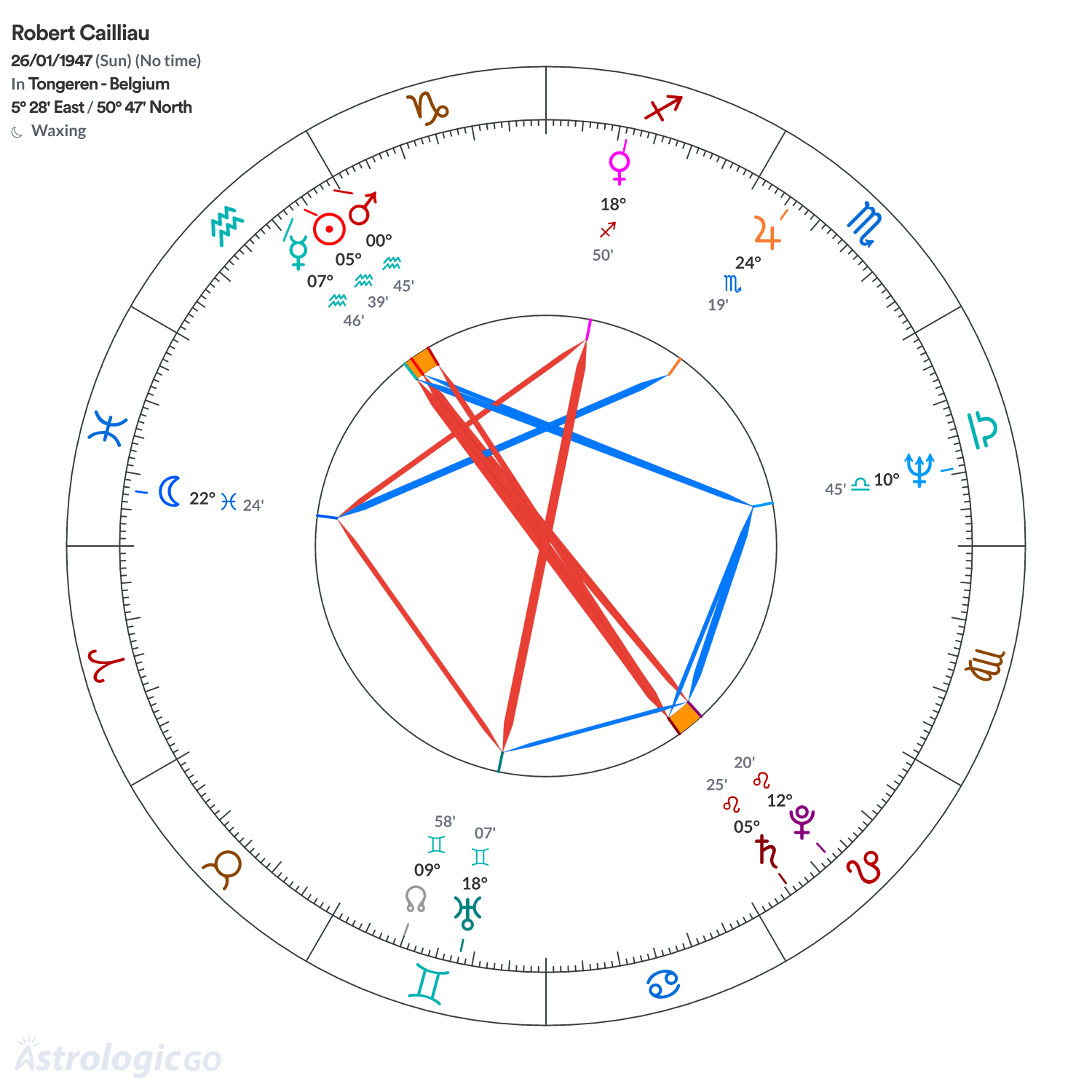
↣ Sun in Aquarius - 05°40'
↣ Moon in Pisces - 22°25'
↣ Mercury in Aquarius - 07°46'
↣ Venus in Sagittarius - 18°50'
↣ Mars in Aquarius - 00°46'
↣ Jupiter in Scorpio - 24°19'
↣ Saturn in Leo - 05°25' - retrograde
↣ Uranus in Gemini - 18°07' - retrograde
↣ Neptune in Libra - 10°45' - retrograde
↣ Pluto in Leo - 12°20' - retrograde
↣ North Node in Gemini - 09°59' - retrograde
Aspects
↣ Sun and Mercury conjunction (2°07' separating) parallel
↣ Sun and Venus parallel
↣ Sun and Mars conjunction (4°54' separating)
↣ Sun and Jupiter parallel
↣ Sun and Saturn opposition (0°14' separating) antiparallel
↣ Sun and Neptune trine (5°06' applying)
↣ Sun and Pluto opposition (6°41' applying)
↣ Sun and North Node trine (4°19' applying)
↣ Moon and Venus square (3°34' separating)
↣ Moon and Jupiter trine (1°54' applying)
↣ Moon and Uranus square (4°17' separating)
↣ Mercury and Mars conjunction (7°01' separating) parallel
↣ Mercury and Saturn opposition (2°21' separating) antiparallel
↣ Mercury and Neptune trine (2°59' applying)
↣ Mercury and Pluto opposition (4°34' applying)
↣ Mercury and North Node trine (2°13' applying)
↣ Venus and Saturn antiparallel
↣ Venus and Uranus opposition (0°43' separating)
↣ Venus and North Node opposition (8°52' separating)
↣ Mars and Saturn opposition (4°40' applying)
↣ Mars and North Node antiparallel
↣ Saturn and Neptune sextile (5°20' separating)
↣ Saturn and Pluto conjunction (6°55' separating)
↣ Saturn and North Node sextile (4°34' applying)
↣ Uranus and Pluto sextile (5°47' applying) parallel
↣ Neptune and Pluto sextile (1°35' applying)
↣ Neptune and North Node trine (0°46' separating)
↣ Pluto and North Node sextile (2°22' separating)
Birth data
- Chart date
- 26/01/1947
- Chart time
- No time
- Date and time quality
- XX Time not informed what does this mean?
- Data origin
- Astro-Databank
- Location
-
 Tongeren, Belgium
 - Latitude and longitude
- 50°47' North · 5°28' East
- Time zone
- 01:00 East
The data used to calculate the charts comes from public sources, as do the descriptive texts. We use sources such as Wikipedia.

About
Robert Cailliau is a Belgian computer engineer whose work was decisive in moving hypertext from an experimental concept to the public Internet. In the late 1980s and early 1990s he proposed a hypertext system at CERN and collaborated with Tim Berners‑Lee in creating and promoting the World Wide Web, a contribution that earned them the ACM Software System Award. Cailliau took part in developing cross‑platform browsers, including contributions to the first Classic Mac OS browser, and coordinated European projects to disseminate information on the web.
As organizer of the first International World Wide Web Conference, held at CERN in 1994, Cailliau played a central role in bringing researchers together and in transferring web development at CERN to international bodies. He also conceived the historic WWW logo and led educational initiatives such as the “Web for Schools” program.
Over his career he received several academic and civil honors, was inducted into the Internet Hall of Fame, and remained active in public communication about the web. After retiring, he continued as an external collaborator on innovation initiatives at CERN, keeping a legacy tied to the web’s early dissemination and governance.


