Birth Chart
Strom Thurmond
James Strom Thurmond
Sun Sagittarius
Moon Aquarius
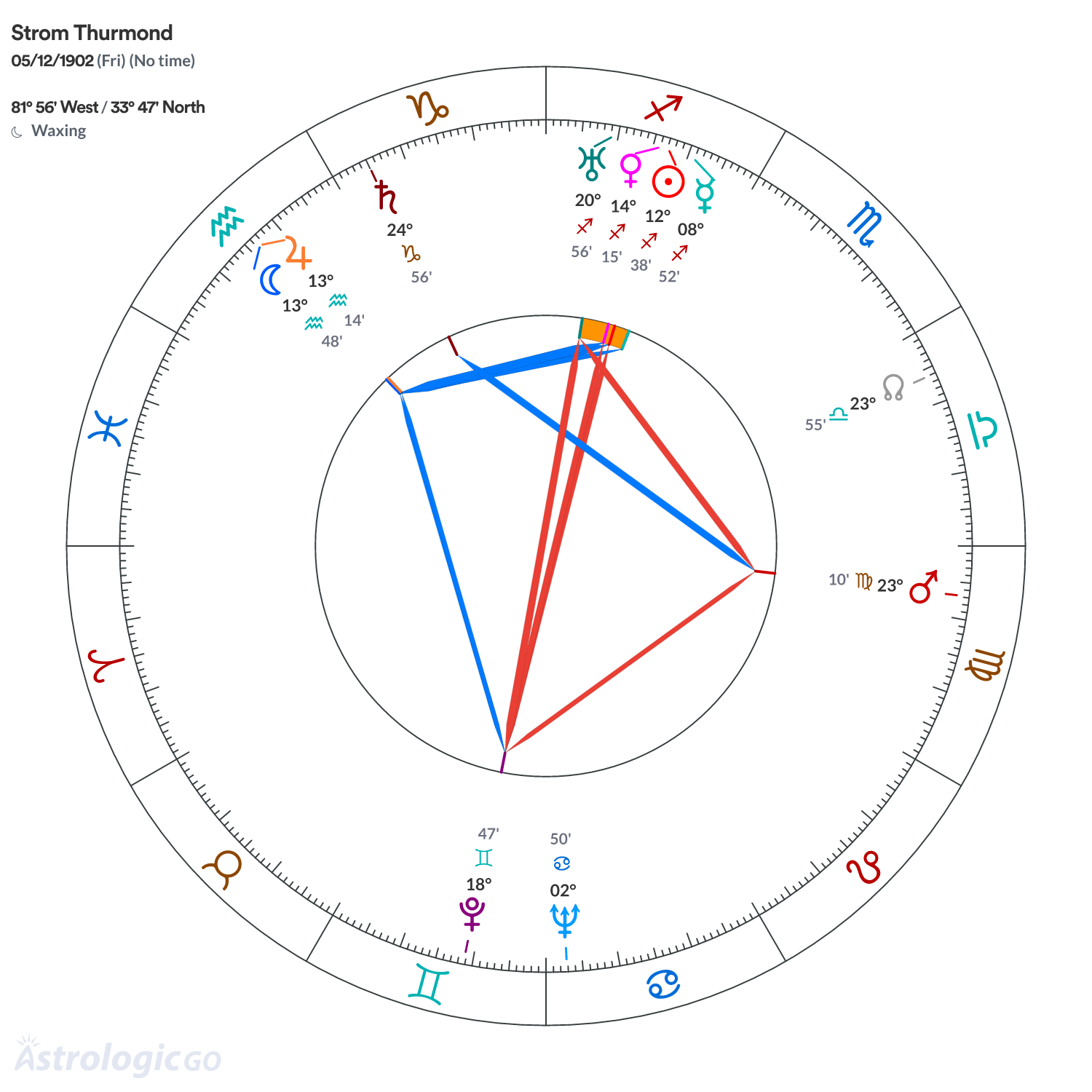
When the birth time is unknown, the chart is calculated for 12:00 noon without using the astrological houses system. Are the planets in the wrong houses?
Influences in signs
↣ Sun in Sagittarius - 12°38'
↣ Moon in Aquarius - 13°49'
↣ Mercury in Sagittarius - 08°52'
↣ Venus in Sagittarius - 14°15'
↣ Mars in Virgo - 23°10'
↣ Jupiter in Aquarius - 13°14'
↣ Saturn in Capricorn - 24°57'
↣ Uranus in Sagittarius - 20°57'
↣ Neptune in Cancer - 02°51' - retrograde
↣ Pluto in Gemini - 18°48' - retrograde
↣ North Node in Libra - 23°56' - retrograde
Aspects
↣ Sun and Moon sextile (1°10' separating)
↣ Sun and Mercury conjunction (3°46' applying) parallel
↣ Sun and Venus conjunction (1°36' separating) parallel
↣ Sun and Jupiter sextile (0°36' applying)
↣ Sun and Saturn parallel
↣ Sun and Uranus conjunction (8°18' applying) parallel
↣ Sun and Neptune antiparallel
↣ Sun and Pluto opposition (6°09' applying)
↣ Moon and Mercury sextile (4°56' separating)
↣ Moon and Venus sextile (0°26' applying)
↣ Moon and Jupiter conjunction (0°34' separating)
↣ Moon and Pluto trine (4°59' applying)
↣ Mercury and Venus conjunction (5°23' applying) parallel
↣ Mercury and Jupiter sextile (4°22' applying)
↣ Mercury and Saturn parallel
↣ Mercury and Uranus parallel
↣ Mercury and Neptune antiparallel
↣ Venus and Jupiter sextile (1°00' separating)
↣ Venus and Uranus conjunction (6°42' applying) parallel
↣ Venus and Neptune antiparallel
↣ Venus and Pluto opposition (4°33' applying)
↣ Mars and Saturn trine (1°47' applying)
↣ Mars and Uranus square (2°13' separating)
↣ Mars and Pluto square (4°22' separating)
↣ Jupiter and Pluto trine (5°33' applying)
↣ Saturn and Neptune antiparallel
↣ Saturn and North Node square (1°01' separating)
↣ Uranus and Neptune antiparallel
↣ Uranus and Pluto opposition (2°09' separating)
↣ Uranus and North Node sextile (2°59' applying)
↣ Pluto and North Node trine (5°08' applying)
Birth data
- Original name
- James Strom Thurmond
- Chart date
- 05/12/1902
- Chart time
- No time
- Date and time quality
- XX Time not informed what does this mean?
- Data origin
- Astro-Databank
- Location
-
 Edgefield (SC), USA
 - Latitude and longitude
- 33°47' North · 81°56' West
- Time zone
- 05:00 West
The data used to calculate the charts comes from public sources, as do the descriptive texts. We use sources such as Wikipedia.

About
Strom Thurmond was an American politician who represented South Carolina in the United States Senate for 47 years, from 1954 to 2003, and previously served as the state’s governor (1947–1951). A lawyer, farmer and prominent figure in Southern politics, he was known for his long legislative career: he served three times as President pro tempore of the Senate and chaired important committees, including the Judiciary Committee (1981–1987) and the Armed Services Committee (1995–1999).
His political career included a 1948 presidential candidacy as leader of the “Dixiecrat” movement, which opposed the federal government’s civil policies, and a historic 24-hour filibuster against the Civil Rights Act of 1957. Initially a member of the Democratic Party, Thurmond switched to the Republican Party in 1964, arguing that the Democratic Party no longer represented his voters.
Thurmond was a firm advocate of states’ rights and opposed several civil rights measures in the 1950s and 1960s, positions that made him notorious and sparked controversy. In later decades he moderated some of his stances, while still framing his arguments in terms of Southern context and tradition.
When he retired in 2003, he left a complex legacy: a record-holder for longevity in Congress and a central figure in 20th-century Southern politics, his career remains the subject of debate over race, power and political change in the United States.