Birth Chart
Subrahmanyan Chandrasekhar
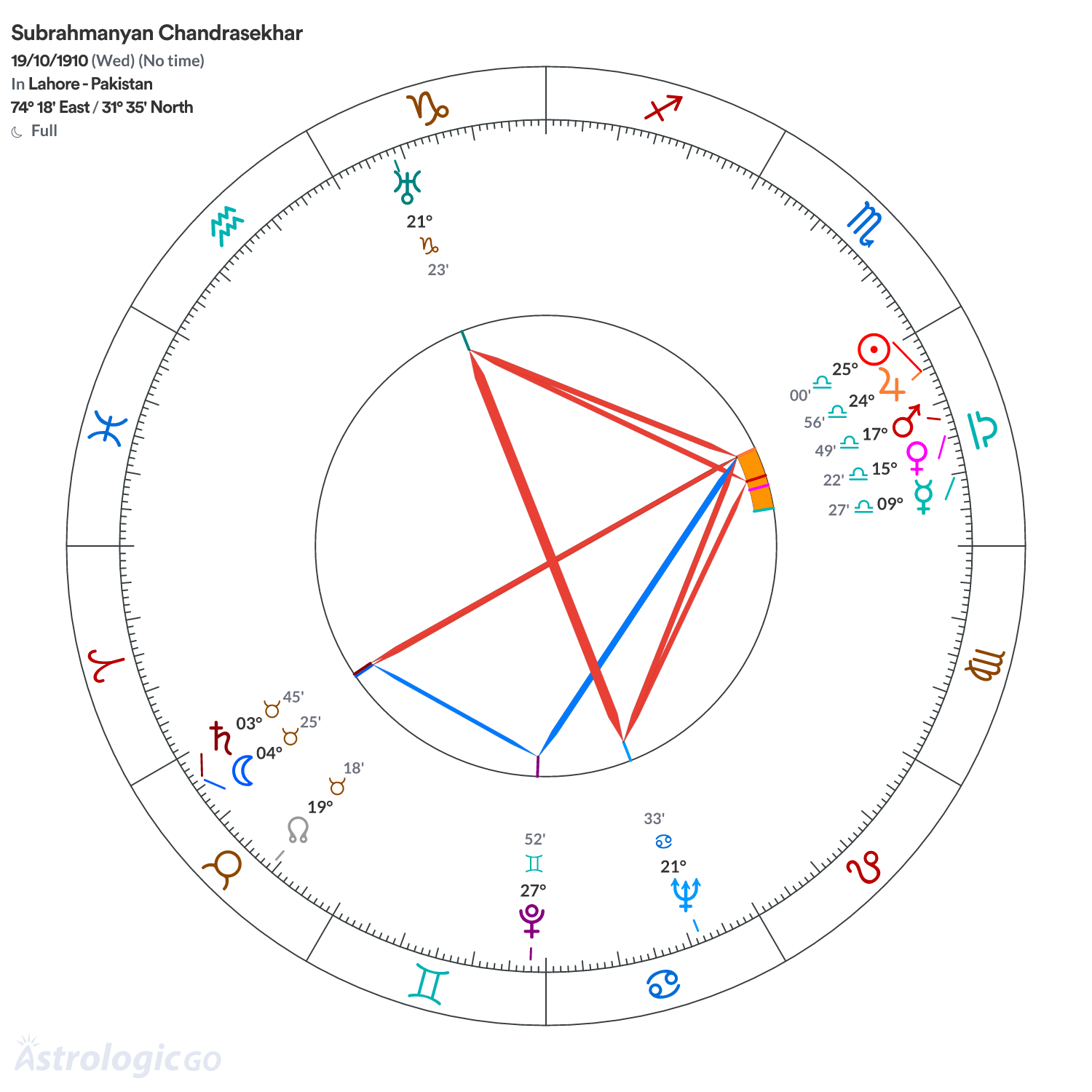
Sun Libra
Moon Aries or Taurus
When the birth time is unknown, the chart is calculated for 12:00 noon without using the astrological houses system. Are the planets in the wrong houses?
Influences in signs
↣ Sun in Libra - 25°00'
↣ Moon in Taurus - 04°26'
↣ Mercury in Libra - 09°28'
↣ Venus in Libra - 15°22'
↣ Mars in Libra - 17°50'
↣ Jupiter in Libra - 24°56'
↣ Saturn in Taurus - 03°45' - retrograde
↣ Uranus in Capricorn - 21°24'
↣ Neptune in Cancer - 21°34'
↣ Pluto in Gemini - 27°52' - retrograde
↣ North Node in Taurus - 19°19' - retrograde
Aspects
↣ Sun and Moon opposition (9°26' separating)
↣ Sun and Venus conjunction (9°38' applying)
↣ Sun and Mars conjunction (7°10' separating)
↣ Sun and Jupiter conjunction (0°04' separating) parallel
↣ Sun and Saturn opposition (8°45' applying) antiparallel
↣ Sun and Uranus square (3°36' separating)
↣ Sun and Neptune square (3°26' separating)
↣ Sun and Pluto trine (2°52' applying)
↣ Moon and Jupiter opposition (9°30' separating)
↣ Moon and Saturn conjunction (0°41' separating)
↣ Mercury and Venus conjunction (5°54' applying)
↣ Mercury and Mars conjunction (8°22' applying)
↣ Venus and Mars conjunction (2°28' applying)
↣ Mars and Jupiter conjunction (7°07' applying)
↣ Mars and Uranus square (3°35' applying)
↣ Mars and Neptune square (3°44' applying)
↣ Jupiter and Saturn opposition (8°49' applying)
↣ Jupiter and Uranus square (3°32' separating)
↣ Jupiter and Neptune square (3°23' separating)
↣ Jupiter and Pluto trine (2°56' applying)
↣ Saturn and Pluto sextile (5°53' applying)
↣ Uranus and Neptune opposition (0°10' applying)
↣ Uranus and North Node trine (2°06' separating)
↣ Neptune and North Node sextile (2°15' separating)
↣ Pluto and North Node parallel
Birth data
- Chart date
- 19/10/1910
- Chart time
- No time
- Date and time quality
- XX Time not informed what does this mean?
- Data origin
- Astro-Databank
- Location
-
 Lahore, Pakistan
 - Latitude and longitude
- 31°35' North · 74°18' East
- Time zone
- 05:30 East
The data used to calculate the charts comes from public sources, as do the descriptive texts. We use sources such as Wikipedia.

About
Subrahmanyan Chandrasekhar was an Indian-born theoretical physicist whose career unfolded mainly in the United States, notable for fundamental contributions to astrophysics and mathematical physics. He received the 1983 Nobel Prize in Physics for theoretical studies of the processes governing the structure and evolution of stars; his formulation of the Chandrasekhar limit (≈1.44 solar masses) established the criterion that determines whether a stellar remnant becomes a white dwarf or collapses into a neutron star or a black hole.
Over the course of his life he addressed a wide range of topics: stellar structure, stellar dynamics, radiative transfer, hydrodynamic and hydromagnetic stability, the quantum theory of the hydrogen anion, general relativity and the mathematical theory of black holes. He developed models that incorporated relativistic corrections to the behavior of degenerate electrons in white dwarfs and introduced concepts such as dynamical friction in studies of gravitational interactions within the galaxy.
A professor for decades at the University of Chicago, he conducted part of his research at the Yerkes Observatory and served as editor of The Astrophysical Journal from 1952 to 1971. His scientific legacy is vast: beyond the limit that bears his name, institutes, concepts and missions — such as the Chandra X-ray Observatory — honor his enduring influence on theoretical astronomy and mathematical physics.


