Birth Chart
Thomas Malthus
Thomas Robert Malthus
Sun Aquarius
Moon Aries
When the birth time is unknown, the chart is calculated for 12:00 noon without using the astrological houses system. Are the planets in the wrong houses?
Influences in signs
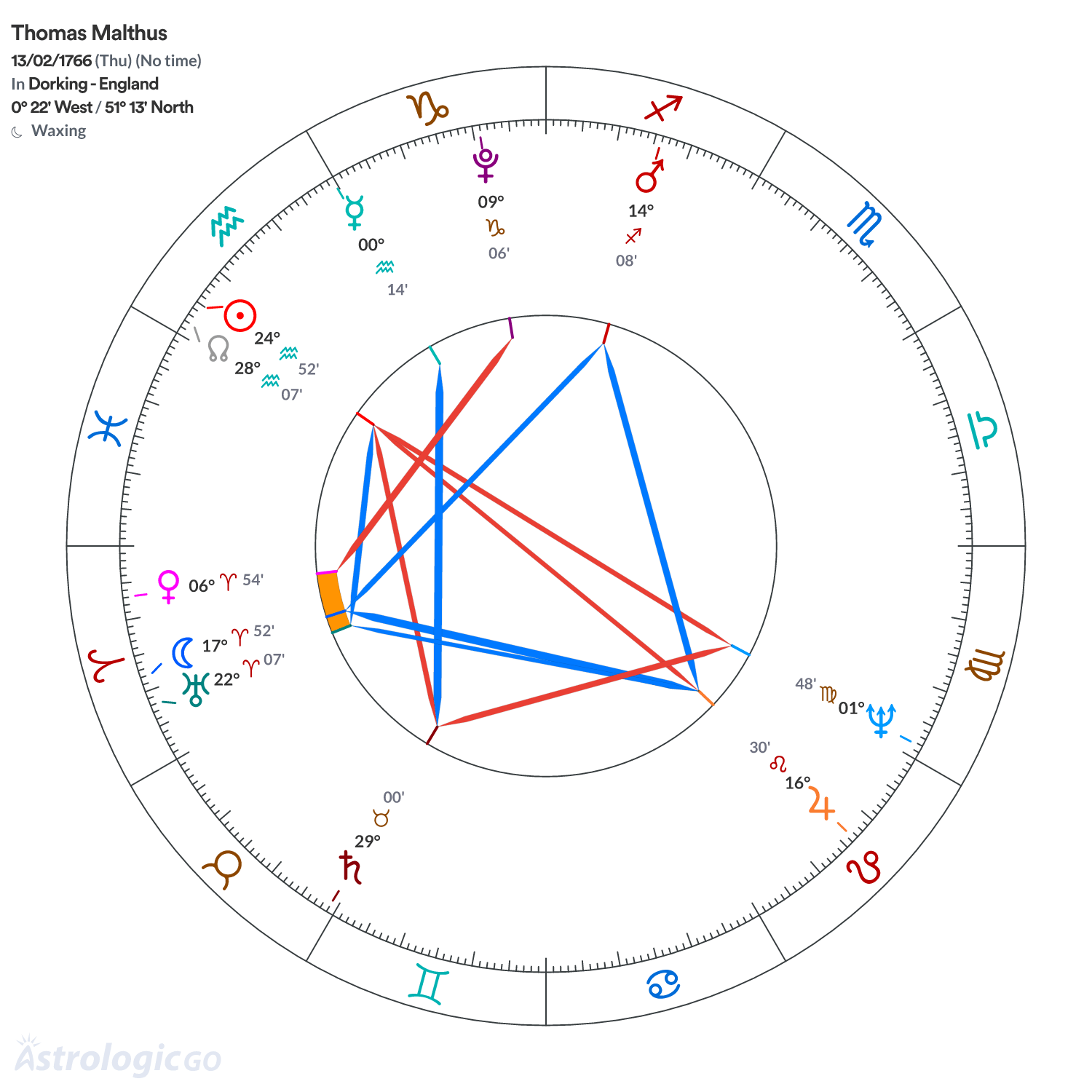
↣ Sun in Aquarius - 24°53'
↣ Moon in Aries - 17°53'
↣ Mercury in Aquarius - 00°14'
↣ Venus in Aries - 06°54'
↣ Mars in Sagittarius - 14°08'
↣ Jupiter in Leo - 16°30' - retrograde
↣ Saturn in Taurus - 29°00'
↣ Uranus in Aries - 22°07'
↣ Neptune in Virgo - 01°49' - retrograde
↣ Pluto in Capricorn - 09°07'
↣ North Node in Aquarius - 28°07'
Aspects
↣ Sun and Jupiter opposition (8°23' separating)
↣ Sun and Saturn square (4°07' applying)
↣ Sun and Uranus sextile (2°46' separating)
↣ Sun and Neptune opposition (6°55' applying)
↣ Sun and North Node conjunction (3°14' applying) parallel
↣ Moon and Venus conjunction (10°58' separating)
↣ Moon and Mars trine (3°44' separating)
↣ Moon and Jupiter trine (1°23' separating)
↣ Moon and Uranus conjunction (4°15' applying)
↣ Moon and Neptune parallel
↣ Moon and North Node antiparallel
↣ Mercury and Saturn trine (1°14' separating)
↣ Mercury and Pluto parallel
↣ Venus and Pluto square (2°12' applying)
↣ Mars and Jupiter trine (2°22' applying)
↣ Jupiter and Uranus trine (5°37' separating)
↣ Saturn and Neptune square (2°48' applying)
↣ Saturn and North Node square (0°53' separating)
↣ Uranus and North Node sextile (6°00' applying)
↣ Neptune and North Node opposition (3°41' applying) antiparallel
Birth data
- Original name
- Thomas Robert Malthus
- Chart date
- 13/02/1766
- Chart time
- No time
- Date and time quality
- XX Time not informed what does this mean?
- Data origin
- Astro-Databank
- Location
-
 Dorking, England
 - Latitude and longitude
- 51°13' North · 0°22' West
- Time zone
- 00:01 West
The data used to calculate the charts comes from public sources, as do the descriptive texts. We use sources such as Wikipedia.

About
Thomas Robert Malthus was an English Anglican clergyman, economist and mathematician, recognized as the founder of demography for his formulation on the limits of population growth. His best‑known work, An Essay on the Principle of Population (1798, and later editions), argues that population tends to grow geometrically while subsistence increases only arithmetically, creating a mismatch that can be checked only by natural restraints or by preventive and moral controls, such as postponing marriage and limiting births.
Graduated from Jesus College, Cambridge, and appointed a professor at the East India Company College, Malthus used empirical observation and the philosophical debates of his time to develop models of marriage, maintenance costs and reproductive behavior, bringing economic questions into social and moral analysis. His views influenced classical economists and provided theoretical inputs that conversed with the evolutionary ideas of Darwin and Wallace.
Although his conclusions have been both criticized and taken up by later movements—such as neo‑Malthusian and eco‑Malthusian currents—his legacy remains central to demographic studies and to reflection on resources, development and population policy.


