Birth Chart
W.E.B. Du Bois
William Edward Burghardt Du Bois
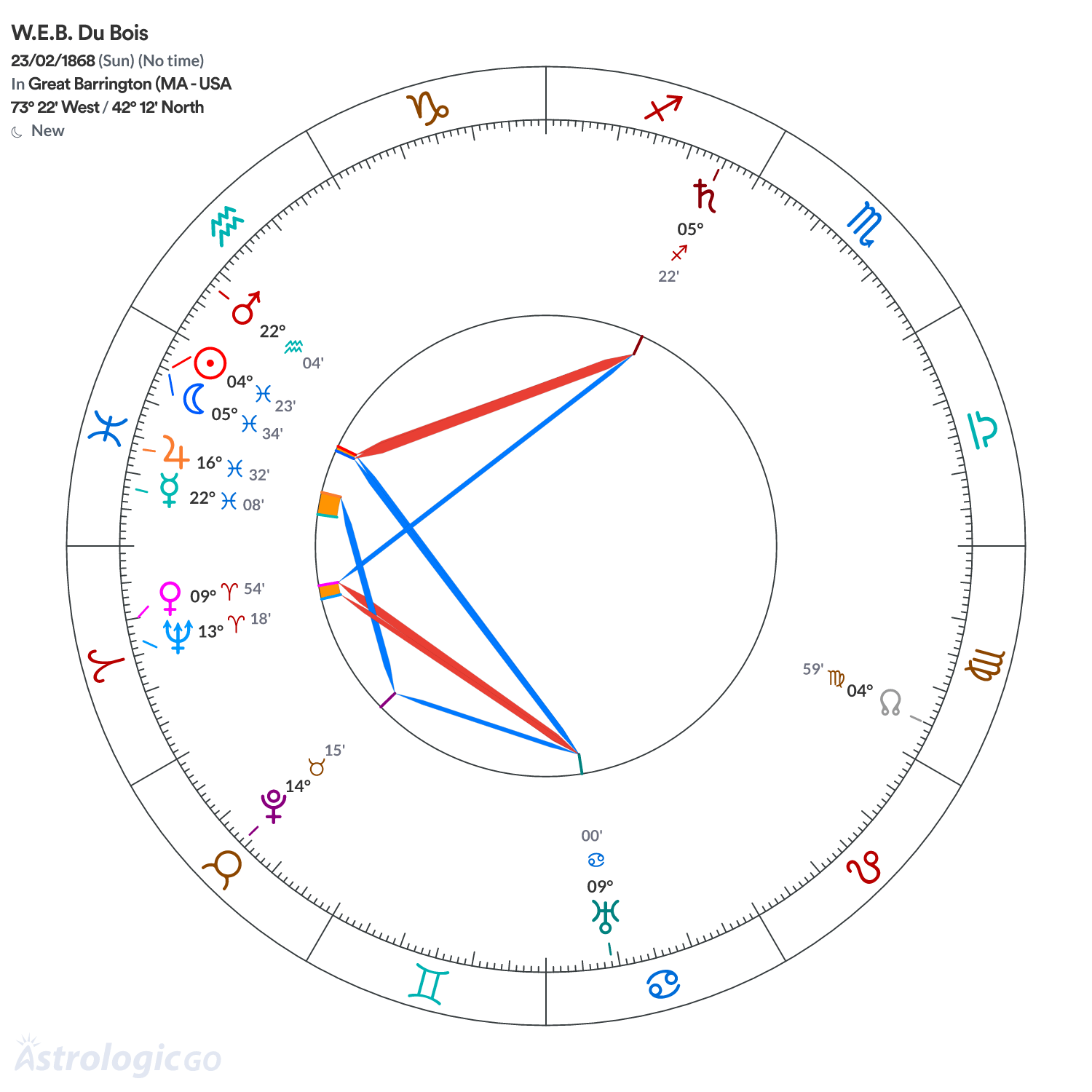
Sun Pisces
Moon Aquarius or Pisces
When the birth time is unknown, the chart is calculated for 12:00 noon without using the astrological houses system. Are the planets in the wrong houses?
Influences in signs
↣ Sun in Pisces - 04°24'
↣ Moon in Pisces - 05°35'
↣ Mercury in Pisces - 22°08'
↣ Venus in Aries - 09°55'
↣ Mars in Aquarius - 22°04'
↣ Jupiter in Pisces - 16°32'
↣ Saturn in Sagittarius - 05°22'
↣ Uranus in Cancer - 09°01' - retrograde
↣ Neptune in Aries - 13°19'
↣ Pluto in Taurus - 14°16'
↣ North Node in Virgo - 04°59'
Aspects
↣ Sun and Moon conjunction (1°11' separating) parallel
↣ Sun and Saturn square (0°58' applying)
↣ Sun and Uranus trine (4°36' applying)
↣ Sun and North Node opposition (0°35' applying) antiparallel
↣ Moon and Saturn square (0°13' separating)
↣ Moon and Uranus trine (3°26' applying)
↣ Moon and North Node opposition (0°35' separating) antiparallel
↣ Mercury and Jupiter conjunction (5°36' separating)
↣ Mercury and Pluto antiparallel
↣ Venus and Saturn trine (4°32' separating)
↣ Venus and Uranus square (0°54' separating)
↣ Venus and Neptune conjunction (3°24' applying) parallel
↣ Jupiter and Pluto sextile (2°17' separating)
↣ Saturn and North Node square (0°22' separating)
↣ Uranus and Neptune square (4°18' separating)
↣ Uranus and Pluto sextile (5°16' separating)
↣ Uranus and North Node sextile (4°01' applying)
Birth data
- Original name
- William Edward Burghardt Du Bois
- Chart date
- 23/02/1868
- Chart time
- No time
- Date and time quality
- XX Time not informed what does this mean?
- Data origin
- Astro-Databank
- Location
-
 Great Barrington (MA), USA
 - Latitude and longitude
- 42°12' North · 73°22' West
- Time zone
- 04:53 West
The data used to calculate the charts comes from public sources, as do the descriptive texts. We use sources such as Wikipedia.

About
W. E. B. Du Bois was an American sociologist, historian, writer and activist whose work shaped twentieth‑century thought on race, civil rights and Pan‑Africanism. A prolific author, he published more than twenty books, notably The Souls of Black Folk, which became a cornerstone of African‑American literature, and Black Reconstruction in America, a study that challenged dominant interpretations of the Reconstruction era after the Civil War.
A Harvard graduate who also studied in Europe, Du Bois combined academic research with public engagement: he chaired the board of the National Association for the Advancement of Colored People (NAACP) and edited the influential journal The Crisis. He led the Niagara Movement, advocated full civil rights and criticized the conciliatory Atlanta Compromise, arguing for the education and leadership of a black intellectual elite — the “talented tenth.”
Internationally, he was prominent as a leader of the Pan‑African movement, organizing congresses to oppose colonialism and support the liberation of colonies. Over his life he linked racism to economic structures and expressed sympathy for socialist positions, while also defending labor rights, peace and disarmament.
His legacy includes the development of theoretical and institutional frameworks that influenced generations of activists, historians and sociologists, establishing him as one of the key figures in the struggle for racial equality and social justice.


