Birth Chart
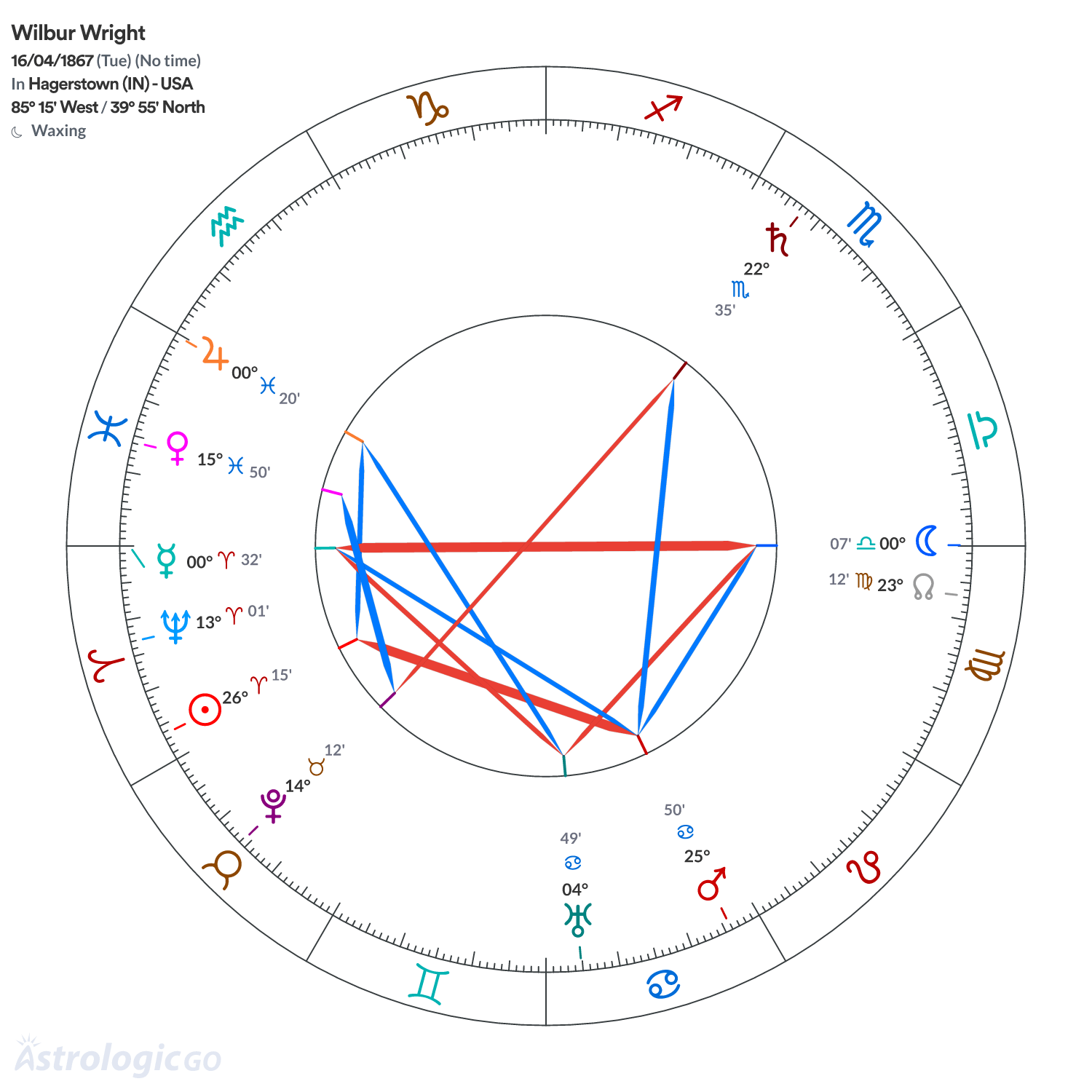
Wilbur Wright
Sun Aries
Moon Virgo or Libra
When the birth time is unknown, the chart is calculated for 12:00 noon without using the astrological houses system. Are the planets in the wrong houses?
Influences in signs
↣ Sun in Aries - 26°16'
↣ Moon in Libra - 00°07'
↣ Mercury in Aries - 00°32'
↣ Venus in Pisces - 15°50'
↣ Mars in Cancer - 25°50'
↣ Jupiter in Pisces - 00°20'
↣ Saturn in Scorpio - 22°36' - retrograde
↣ Uranus in Cancer - 04°50'
↣ Neptune in Aries - 13°02'
↣ Pluto in Taurus - 14°12'
↣ North Node in Virgo - 23°13' - retrograde
Aspects
↣ Sun and Mars square (0°25' separating)
↣ Sun and Jupiter sextile (4°05' applying)
↣ Moon and Mercury opposition (0°25' applying) antiparallel
↣ Moon and Mars sextile (4°17' separating)
↣ Moon and Uranus square (4°42' applying)
↣ Moon and Pluto parallel
↣ Moon and North Node conjunction (6°55' separating)
↣ Mercury and Mars trine (4°42' separating)
↣ Mercury and Uranus square (4°17' applying)
↣ Mercury and Pluto antiparallel
↣ Mercury and North Node opposition (7°20' separating)
↣ Venus and Pluto sextile (1°38' separating)
↣ Venus and North Node opposition (7°22' applying)
↣ Mars and Saturn trine (3°14' separating)
↣ Mars and Uranus parallel
↣ Mars and North Node sextile (2°38' separating)
↣ Jupiter and Uranus trine (4°29' applying)
↣ Saturn and Pluto opposition (8°24' applying)
↣ Saturn and North Node sextile (0°36' separating)
Birth data
- Chart date
- 16/04/1867
- Chart time
- No time
- Date and time quality
- XX Time not informed what does this mean?
- Data origin
- Astro-Databank
- Location
-
 Hagerstown (IN), USA
 - Latitude and longitude
- 39°55' North · 85°15' West
- Time zone
- 05:41 West
The data used to calculate the charts comes from public sources, as do the descriptive texts. We use sources such as Wikipedia.

About
Wilbur Wright was one of two American brothers who led the earliest practical advances in aviation. Together with Orville, he became known as an inventor and experimenter and co‑developed the wing‑warping technique — twisting the wings to control roll — which made controlled flight in heavier‑than‑air machines possible. That control solution and its associated patent were central to turning the dream of flight into practical aviation.
The brothers emphasized methodical investigation: they built and used a homemade wind tunnel to obtain unprecedented aerodynamic data, designing wings and propellers more efficient than those of their contemporaries. Rather than concentrating solely on more powerful engines, they developed a reliable control system that became a key element in fixed‑wing aircraft.
Beyond the technical invention, Wilbur was seen as the intellectual leader of the pair during the early phase of their work, directing research, glider testing, and promoting the conclusions they drew. The Wrights’ legacy lies in founding modern aviation: their control innovations and experimental methodology influenced aircraft design and the shift to powered flight.


