Birth Chart
Willard Van Orman Quine
Sun Cancer
Moon Taurus or Gemini
When the birth time is unknown, the chart is calculated for 12:00 noon without using the astrological houses system. Are the planets in the wrong houses?
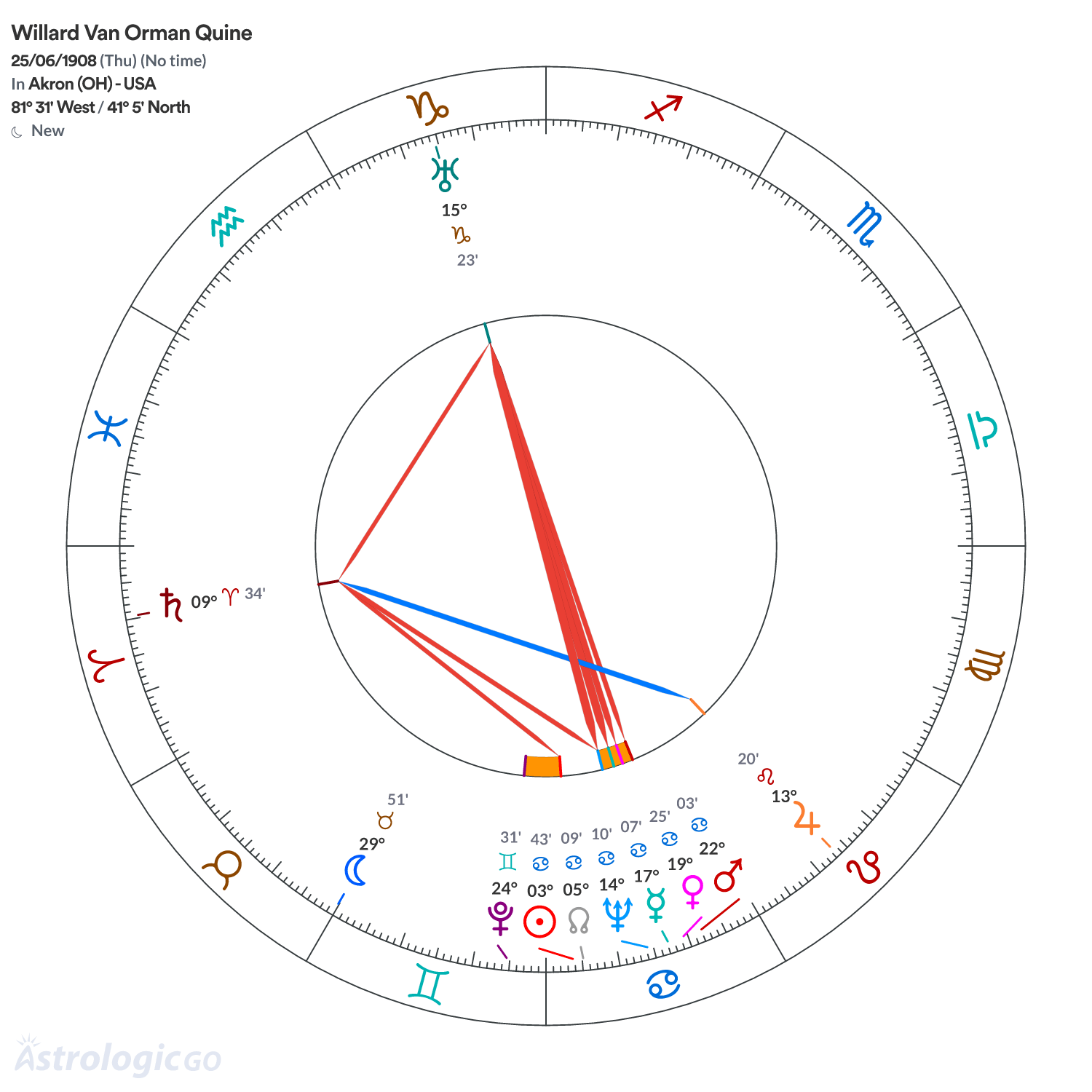
Influences in signs
↣ Sun in Cancer - 03°43'
↣ Moon in Taurus - 29°52'
↣ Mercury in Cancer - 17°07' - retrograde
↣ Venus in Cancer - 19°25' - retrograde
↣ Mars in Cancer - 22°04'
↣ Jupiter in Leo - 13°21'
↣ Saturn in Aries - 09°35'
↣ Uranus in Capricorn - 15°23' - retrograde
↣ Neptune in Cancer - 14°10'
↣ Pluto in Gemini - 24°32'
↣ North Node in Cancer - 05°09' - retrograde
Aspects
↣ Sun and Mars parallel
↣ Sun and Saturn square (5°51' applying)
↣ Sun and Uranus antiparallel
↣ Sun and Neptune parallel
↣ Sun and Pluto conjunction (9°12' separating)
↣ Sun and North Node conjunction (1°25' applying) parallel
↣ Moon and Jupiter parallel
↣ Moon and Pluto parallel
↣ Mercury and Venus conjunction (2°18' applying) parallel
↣ Mercury and Mars conjunction (4°56' separating)
↣ Mercury and Uranus opposition (1°44' applying)
↣ Mercury and Neptune conjunction (2°57' applying)
↣ Venus and Mars conjunction (2°38' separating)
↣ Venus and Uranus opposition (4°02' applying)
↣ Venus and Neptune conjunction (5°15' applying)
↣ Mars and Uranus opposition (6°40' separating) antiparallel
↣ Mars and Neptune conjunction (7°53' separating) parallel
↣ Mars and North Node parallel
↣ Jupiter and Saturn trine (3°46' separating)
↣ Saturn and Uranus square (5°49' applying)
↣ Saturn and Neptune square (4°35' applying)
↣ Saturn and North Node square (4°26' separating)
↣ Uranus and Neptune opposition (1°13' applying)
↣ Uranus and North Node antiparallel
Birth data
- Chart date
- 25/06/1908
- Chart time
- No time
- Date and time quality
- XX Time not informed what does this mean?
- Data origin
- Astro-Databank
- Location
-
 Akron (OH), USA
 - Latitude and longitude
- 41°05' North · 81°31' West
- Time zone
- 06:00 West
The data used to calculate the charts comes from public sources, as do the descriptive texts. We use sources such as Wikipedia.

About
Willard Van Orman Quine was one of the most influential American philosophers and logicians of the twentieth century and a central figure in the analytic tradition. A professor at Harvard for decades, he held the Edgar Pierce Chair (1956–1978) and was notable for both his mathematical training and his philosophical work on language, knowledge, and logic.
His critical writing is highlighted by seminal essays such as “Two Dogmas of Empiricism,” in which he challenged the distinction between analytic and synthetic judgments and defended an epistemological holism that shaped debates on verification and meaning. In Word and Object he further developed the thesis of the indeterminacy of translation, deepening his views on the relationship between language and reality.
Quine also made extensive contributions to logic and mathematics, publishing on class calculus, type theory, and the foundations of symbolic logic. That combination of logical technique and philosophical reflection secured his legacy: a sustained critique of traditional empiricism and a lasting influence on the philosophy of language, epistemology, and mathematical logic.


