Birth Chart
William Henry Bragg
Sun Cancer
Moon Virgo
When the birth time is unknown, the chart is calculated for 12:00 noon without using the astrological houses system. Are the planets in the wrong houses?
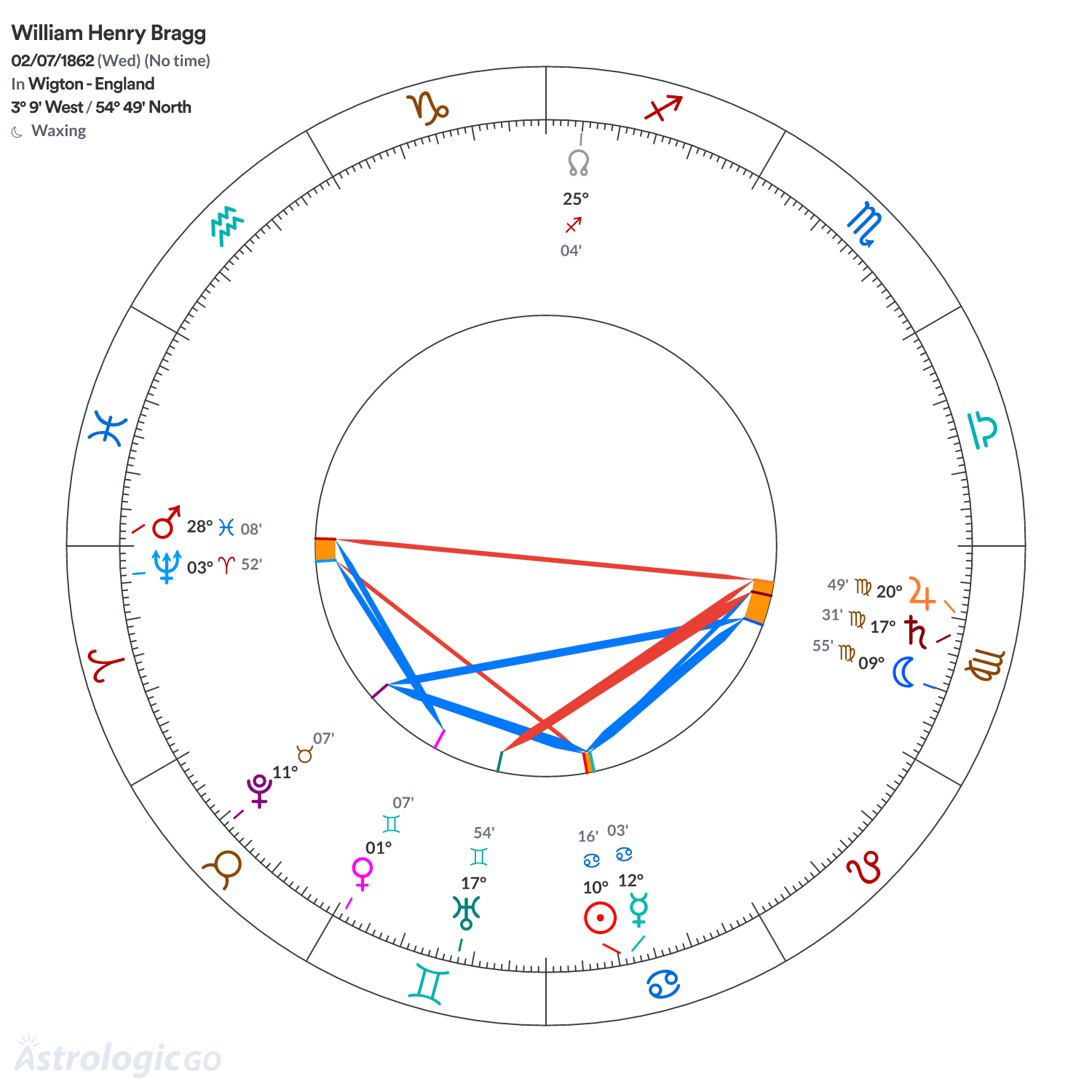
Influences in signs
↣ Sun in Cancer - 10°17'
↣ Moon in Virgo - 09°55'
↣ Mercury in Cancer - 12°04' - retrograde
↣ Venus in Gemini - 01°08'
↣ Mars in Pisces - 28°09'
↣ Jupiter in Virgo - 20°50'
↣ Saturn in Virgo - 17°32'
↣ Uranus in Gemini - 17°55'
↣ Neptune in Aries - 03°52'
↣ Pluto in Taurus - 11°08'
↣ North Node in Sagittarius - 25°04' - retrograde
Aspects
↣ Sun and Moon sextile (0°22' applying)
↣ Sun and Mercury conjunction (1°47' applying)
↣ Sun and Uranus parallel
↣ Sun and Neptune square (6°25' separating)
↣ Sun and Pluto sextile (0°51' applying)
↣ Sun and North Node antiparallel
↣ Moon and Mercury sextile (2°09' applying)
↣ Moon and Mars antiparallel
↣ Moon and Saturn conjunction (7°37' applying)
↣ Moon and Pluto trine (1°13' applying)
↣ Mercury and Venus parallel
↣ Mercury and Saturn sextile (5°28' separating)
↣ Mercury and Pluto sextile (0°56' applying)
↣ Venus and Mars sextile (2°59' separating)
↣ Venus and Neptune sextile (2°44' applying)
↣ Mars and Jupiter opposition (7°19' separating) antiparallel
↣ Mars and Neptune conjunction (5°43' applying)
↣ Mars and North Node square (3°05' separating)
↣ Jupiter and Saturn conjunction (3°18' separating)
↣ Jupiter and Uranus square (2°55' separating)
↣ Jupiter and North Node square (4°14' applying)
↣ Saturn and Uranus square (0°23' applying)
↣ Uranus and North Node opposition (7°09' applying) antiparallel
↣ Neptune and Pluto parallel
Birth data
- Chart date
- 02/07/1862
- Chart time
- No time
- Date and time quality
- XX Time not informed what does this mean?
- Data origin
- Astro-Databank
- Location
-
 Wigton, England
 - Latitude and longitude
- 54°49' North · 3°09' West
- Time zone
- 00:00
The data used to calculate the charts comes from public sources, as do the descriptive texts. We use sources such as Wikipedia.

About
Sir William Henry Bragg was a British physicist and mathematician whose pioneering work with X-rays in the analysis of crystal structure earned him, together with his son Lawrence Bragg, the 1915 Nobel Prize in Physics. Educated at Cambridge, Bragg built an academic career at the University of Adelaide, where he reformed teaching and scientific facilities, promoted student training, and fostered the dissemination of knowledge.
During his time in Australia he pursued work in electromagnetism, radiography, and wireless telegraphy, giving the country’s first public demonstrations of X-ray applications and radio. His investigations into ionization and particle emissions paved the way for further research in radioactivity and led to scientific recognition, including election to the Royal Society.
After returning to England, Bragg strengthened his influence in experimental physics and X-ray crystallography, contributing to a decisive method for determining atomic structures. His legacy combines theoretical and practical scientific achievements, institutional impact on education, and international recognition for advances that became fundamental to structural physics and chemistry.


