Birth Chart
Zoltán Kodály
Sun Sagittarius
Moon Pisces
When the birth time is unknown, the chart is calculated for 12:00 noon without using the astrological houses system. Are the planets in the wrong houses?
Influences in signs
↣ Sun in Sagittarius - 24°26'
↣ Moon in Pisces - 08°04'
↣ Mercury in Sagittarius - 24°00'
↣ Venus in Sagittarius - 09°13' - retrograde
↣ Mars in Sagittarius - 22°57'
↣ Jupiter in Gemini - 26°37' - retrograde
↣ Saturn in Taurus - 20°22' - retrograde
↣ Uranus in Virgo - 23°17'
↣ Neptune in Taurus - 16°29' - retrograde
↣ Pluto in Taurus - 28°50' - retrograde
↣ North Node in Scorpio - 20°02' - retrograde
Aspects
↣ Sun and Mercury conjunction (0°26' applying) parallel
↣ Sun and Mars conjunction (1°29' separating) parallel
↣ Sun and Jupiter opposition (2°10' applying) antiparallel
↣ Sun and Uranus square (1°09' separating)
↣ Moon and Venus square (1°09' applying)
↣ Moon and Uranus antiparallel
↣ Mercury and Mars conjunction (1°03' separating) parallel
↣ Mercury and Jupiter opposition (2°37' applying)
↣ Mercury and Uranus square (0°43' separating)
↣ Mars and Jupiter opposition (3°40' applying) antiparallel
↣ Mars and Uranus square (0°20' applying)
↣ Jupiter and Uranus square (3°19' applying)
↣ Saturn and Uranus trine (2°55' separating)
↣ Saturn and Neptune conjunction (3°53' applying) parallel
↣ Saturn and Pluto conjunction (8°27' separating)
↣ Saturn and North Node opposition (0°21' applying)
↣ Uranus and Pluto trine (5°32' applying)
↣ Uranus and North Node sextile (3°15' separating)
↣ Neptune and North Node opposition (3°33' applying)
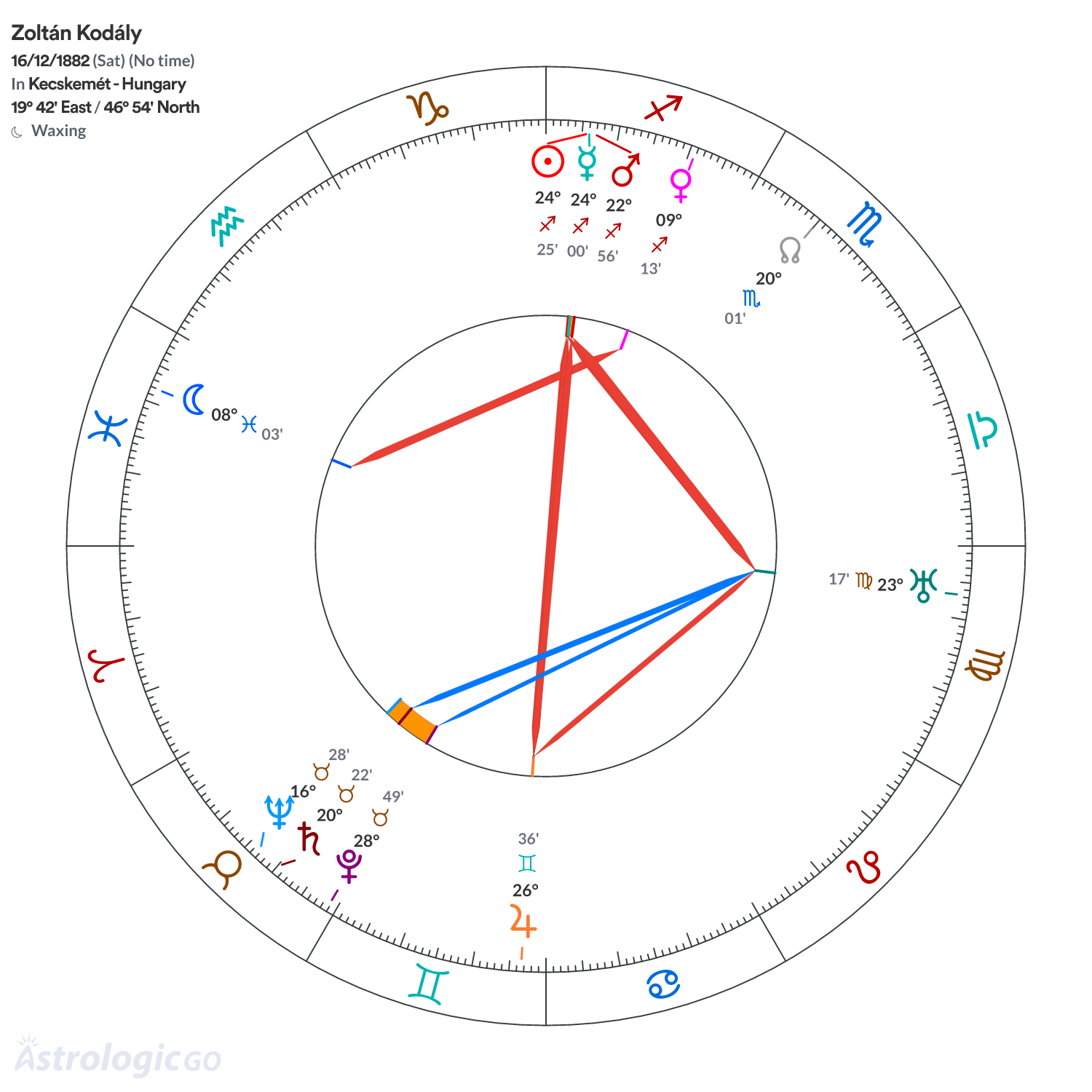
Birth data
- Chart date
- 16/12/1882
- Chart time
- No time
- Date and time quality
- XX Time not informed what does this mean?
- Data origin
- Astro-Databank
- Location
-
 Kecskemét, Hungary
 - Latitude and longitude
- 46°54' North · 19°42' East
- Time zone
- 01:19 East
The data used to calculate the charts comes from public sources, as do the descriptive texts. We use sources such as Wikipedia.

About
Zoltán Kodály was a Hungarian composer whose work and activities deeply shaped twentieth-century music and music education. Trained at the Franz Liszt Academy and drawing on influences from Viennese post‑Romanticism to Central European folk traditions, Kodály combined technical rigor with ethnomusicological research, incorporating Hungarian and neighboring countries’ folk melodies into chamber, choral, and orchestral works.
As a researcher he collected an extensive repertory of songs and melodies — more than one hundred thousand entries — which informed both his compositions and the preservation of musical heritage. Notable works include Psalmus Hungaricus, the Dances of Marosszék, and a body of quartets, sonatas, and choral pieces that reflect his interest in popular tradition and compositional modernity.
In pedagogy, the Kodály Method became an international reference, inspiring music literacy practices centered on the voice, the use of folk material, and a disciplined pedagogical progression. He held prominent academic and institutional positions and received multiple international honors, securing a lasting legacy as a composer, ethnomusicologist, and educator.


