Birth Chart
Cláudio Correia e Castro
Cláudio Luís Murgel Corrêa e Castro
Sun Pisces
Moon Capricorn
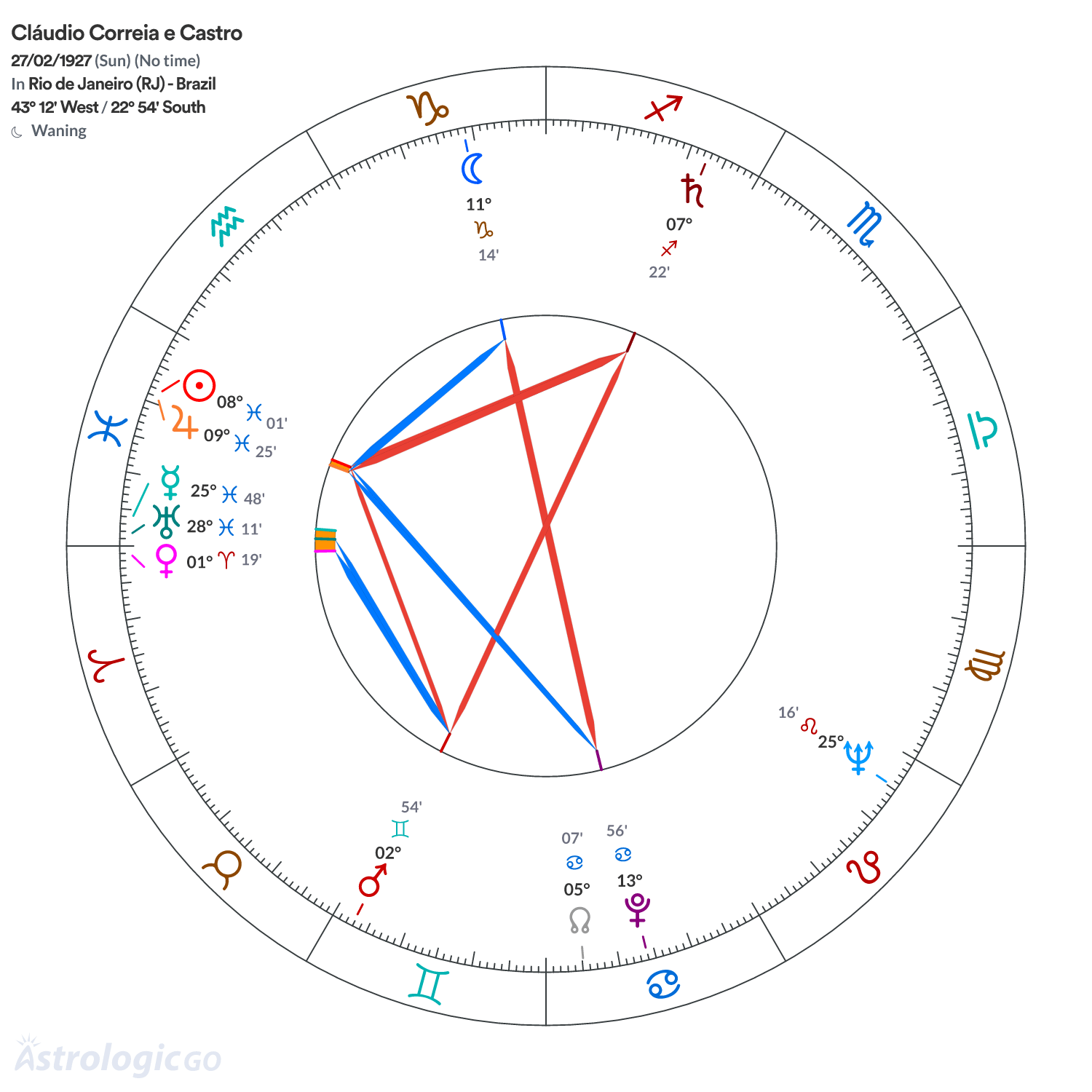
When the birth time is unknown, the chart is calculated for 12:00 noon without using the astrological houses system. Are the planets in the wrong houses?
Influences in signs
↣ Sun in Pisces - 08°02'
↣ Moon in Capricorn - 11°14'
↣ Mercury in Pisces - 25°49'
↣ Venus in Aries - 01°20'
↣ Mars in Gemini - 02°55'
↣ Jupiter in Pisces - 09°25'
↣ Saturn in Sagittarius - 07°23'
↣ Uranus in Pisces - 28°11'
↣ Neptune in Leo - 25°16' - retrograde
↣ Pluto in Cancer - 13°56' - retrograde
↣ North Node in Cancer - 05°08' - retrograde
Aspects
↣ Sun and Moon sextile (3°13' separating)
↣ Sun and Mars square (5°07' separating)
↣ Sun and Jupiter conjunction (1°24' applying) parallel
↣ Sun and Saturn square (0°39' separating)
↣ Sun and Pluto trine (5°55' applying)
↣ Sun and North Node trine (2°54' separating)
↣ Moon and Mars antiparallel
↣ Moon and Jupiter sextile (1°49' separating)
↣ Moon and Pluto opposition (2°42' applying)
↣ Moon and North Node opposition (6°07' separating) antiparallel
↣ Mercury and Venus conjunction (5°31' separating) antiparallel
↣ Mercury and Uranus conjunction (2°23' applying)
↣ Venus and Mars sextile (1°35' applying)
↣ Venus and Uranus conjunction (3°08' separating) parallel
↣ Venus and North Node square (3°48' applying)
↣ Mars and Saturn opposition (4°28' applying)
↣ Mars and Uranus sextile (4°43' separating)
↣ Mars and North Node parallel
↣ Jupiter and Saturn square (2°02' separating)
↣ Jupiter and Pluto trine (4°31' applying)
↣ Jupiter and North Node trine (4°18' separating)
Birth data
- Original name
- Cláudio Luís Murgel Corrêa e Castro
- Chart date
- 27/02/1927
- Chart time
- No time
- Date and time quality
- XX Time not informed what does this mean?
- Data origin
- Wikipedia
- Location
-
 Rio de Janeiro (RJ), Brazil
 - Latitude and longitude
- 22°54' South · 43°12' West
- Time zone
- 03:00 West
The data used to calculate the charts comes from public sources, as do the descriptive texts. We use sources such as Wikipedia.

About
Cláudio Luís Murgel Corrêa e Castro was a Brazilian actor.
He was one of the record-holders for appearances in Brazilian telenovelas, acting in more than forty soap operas.
He was notable for characters such as Mr. Leopoldo in Força de um Desejo (1999), Count Klaus in Chocolate com Pimenta (2003), and Gugu in A Gata Comeu (1985), among others.
In film, he worked in O Grande Mentecapto, by Oswaldo Caldeira, in 1985, and in Tiradentes, also by Oswaldo Caldeira, in 1999.


