Birth Chart
Giacomo Casanova
Giacomo Jacopo Casanova de Seingalt
Sun Aries
Moon Scorpio or Sagittarius
When the birth time is unknown, the chart is calculated for 12:00 noon without using the astrological houses system. Are the planets in the wrong houses?
Influences in signs
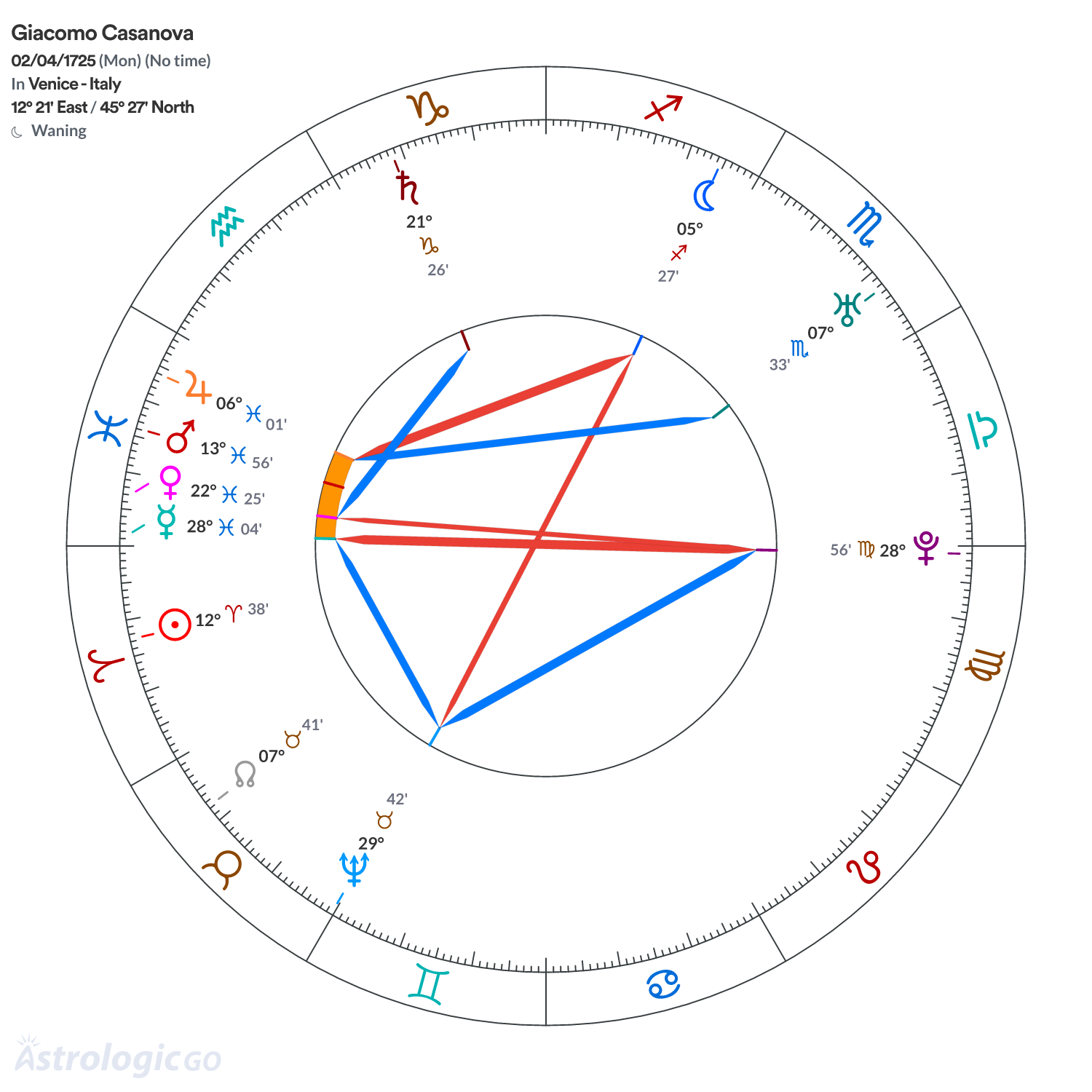
↣ Sun in Aries - 12°38'
↣ Moon in Sagittarius - 05°28'
↣ Mercury in Pisces - 28°05'
↣ Venus in Pisces - 22°26'
↣ Mars in Pisces - 13°56'
↣ Jupiter in Pisces - 06°01'
↣ Saturn in Capricorn - 21°26'
↣ Uranus in Scorpio - 07°34' - retrograde
↣ Neptune in Taurus - 29°43'
↣ Pluto in Virgo - 28°56' - retrograde
↣ North Node in Taurus - 07°41'
Aspects
↣ Sun and Venus antiparallel
↣ Moon and Jupiter square (0°33' applying)
↣ Moon and Neptune opposition (5°45' separating)
↣ Mercury and Venus conjunction (5°39' separating)
↣ Mercury and Neptune sextile (1°38' applying)
↣ Mercury and Pluto opposition (0°52' applying)
↣ Venus and Mars conjunction (8°29' separating)
↣ Venus and Saturn sextile (0°59' separating)
↣ Venus and Pluto opposition (6°31' applying)
↣ Mars and Jupiter conjunction (7°56' separating)
↣ Jupiter and Uranus trine (1°33' applying)
↣ Jupiter and North Node sextile (1°40' applying)
↣ Uranus and North Node opposition (0°08' separating) antiparallel
↣ Neptune and Pluto trine (0°46' separating)
Birth data
- Original name
- Giacomo Jacopo Casanova de Seingalt
- Chart date
- 02/04/1725
- Chart time
- No time
- Date and time quality
- XX Time not informed what does this mean?
- Data origin
- Astro-Databank
- Location
-
 Venice, Italy
 - Latitude and longitude
- 45°27' North · 12°21' East
- Time zone
- 00:49 East
The data used to calculate the charts comes from public sources, as do the descriptive texts. We use sources such as Wikipedia.

About
Giacomo Girolamo Casanova was a writer, adventurer, and emblematic figure of eighteenth‑century Europe, born in what was then the Republic of Venice. He became known both for his voluminous memoirs — History of My Life — and for his intense presence in the salons, courts, and libraries of the Enlightenment, moving between Paris, Vienna, Saint Petersburg, Prague, and Istanbul. His works and accounts are key sources for understanding the customs, social habits, and cultural life of the period.
Casanova’s career included frustrated attempts at military and ecclesiastical professions, a celebrated escape from the prisons of the Doge’s Palace in Venice in 1756, and a long wandering life marked by gambling, debts, and intrigue. He also worked as a lecturer, playwright, and translator, and wrote numerous pamphlets, plays, and studies, in addition to treatises on literary and scientific subjects.
Appointed librarian to the Count of Waldstein in Dux, Bohemia, he spent his final years writing novels and, above all, the autobiography that became an indispensable source for historians and readers of the period. Casanova’s legacy blends a reputation as a seducer, a chronicler of his age, and a valuable witness to the society of the Ancien Régime.


