Birth Chart
John Marshall
Sun Libra
Moon Taurus
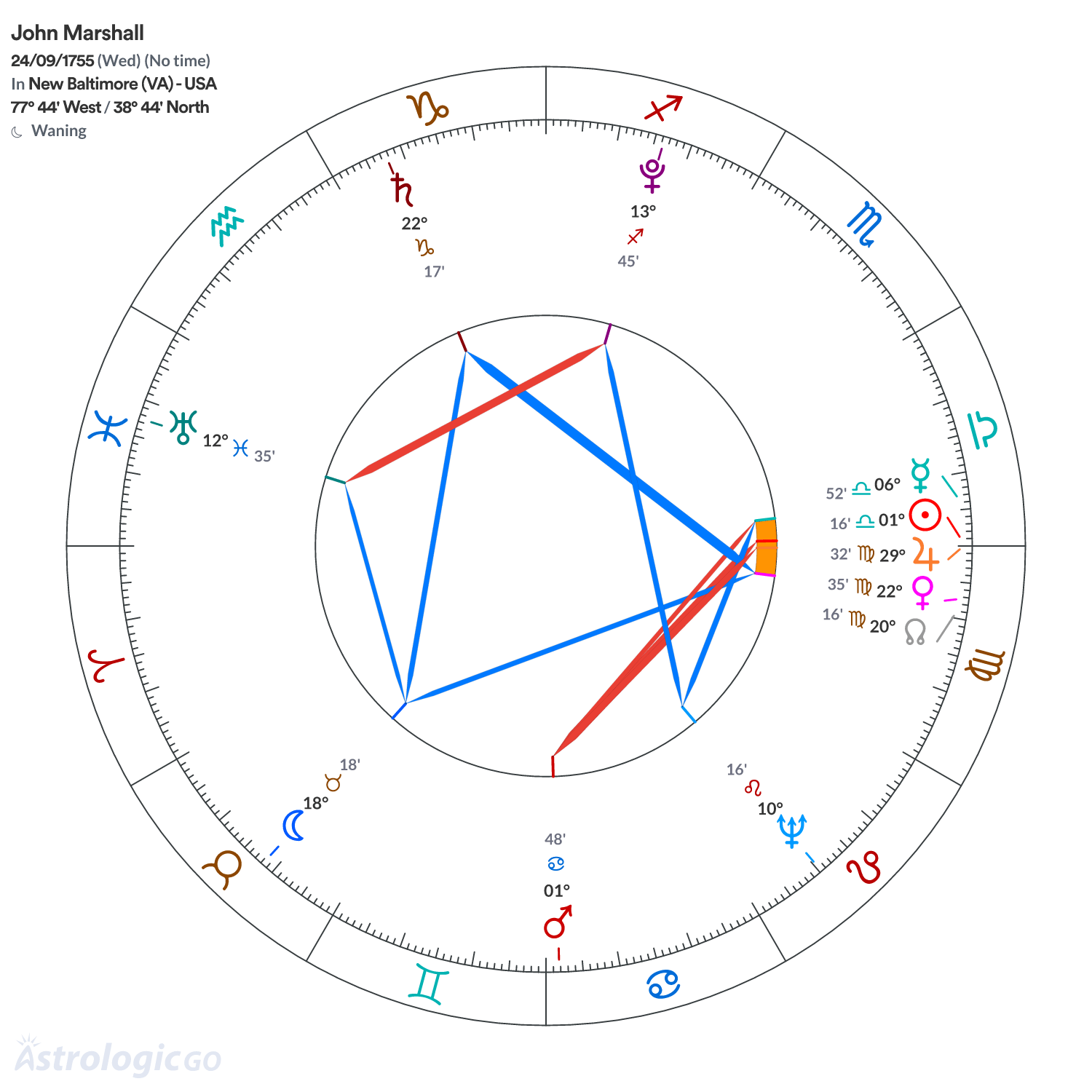
When the birth time is unknown, the chart is calculated for 12:00 noon without using the astrological houses system. Are the planets in the wrong houses?
Influences in signs
↣ Sun in Libra - 01°17'
↣ Moon in Taurus - 18°19'
↣ Mercury in Libra - 06°53'
↣ Venus in Virgo - 22°35'
↣ Mars in Cancer - 01°49'
↣ Jupiter in Virgo - 29°32'
↣ Saturn in Capricorn - 22°17' - retrograde
↣ Uranus in Pisces - 12°35' - retrograde
↣ Neptune in Leo - 10°17'
↣ Pluto in Sagittarius - 13°46'
↣ North Node in Virgo - 20°17' - retrograde
Aspects
↣ Sun and Mercury conjunction (5°36' separating) parallel
↣ Sun and Venus conjunction (8°41' applying)
↣ Sun and Mars square (0°32' applying)
↣ Sun and Jupiter conjunction (1°44' separating) antiparallel
↣ Moon and Venus trine (4°17' applying)
↣ Moon and Saturn trine (3°59' applying)
↣ Moon and Uranus sextile (5°43' separating)
↣ Moon and Pluto antiparallel
↣ Moon and North Node trine (1°58' applying)
↣ Mercury and Mars square (5°04' separating)
↣ Mercury and Jupiter conjunction (7°21' separating) antiparallel
↣ Mercury and Neptune sextile (3°24' applying)
↣ Venus and Jupiter conjunction (6°56' applying)
↣ Venus and Saturn trine (0°18' separating)
↣ Venus and North Node conjunction (2°19' separating) parallel
↣ Mars and Jupiter square (2°17' separating)
↣ Saturn and North Node trine (2°01' separating)
↣ Uranus and Pluto square (1°10' separating)
↣ Uranus and North Node opposition (7°41' separating)
↣ Neptune and Pluto trine (3°29' applying)
Birth data
- Chart date
- 24/09/1755
- Chart time
- No time
- Date and time quality
- XX Time not informed what does this mean?
- Data origin
- Astro-Databank
- Location
-
 New Baltimore (VA), USA
 - Latitude and longitude
- 38°44' North · 77°44' West
- Time zone
- 05:11 West
The data used to calculate the charts comes from public sources, as do the descriptive texts. We use sources such as Wikipedia.

About
John Marshall was an American lawyer and politician who served as the fourth Chief Justice of the United States from 1801 until his death in 1835. Before joining the Court, he served as Secretary of State under John Adams, as a member of the Virginia House of Delegates and of the U.S. Congress, and fought in the Revolutionary War as an officer in the Continental Army.
As Chief Justice, Marshall established foundational legal doctrines that shaped the role of the American judiciary. His opinion in Marbury v. Madison (1803) established the power of judicial review, enabling courts to strike down laws inconsistent with the Constitution. In subsequent decisions, the Court under his leadership affirmed federal supremacy over the states and protected contracts and federal institutions, notably in McCulloch v. Maryland, Dartmouth College v. Woodward, and Gibbons v. Ogden.
Marshall also defined the Supreme Court’s authority over state courts and addressed the rights of Native peoples in Worcester v. Georgia. His long tenure and rulings deeply influenced the structure of the federal government and the development of United States constitutional law, leaving a lasting legacy in American jurisprudence.